
OCR A Physics OCR Paper 3 2020
- Answer all the questions.
- 1. Where appropriate, your answer should be supported with working. Marks might be given for using a correct method, even if your answer is wrong.
- Answer all the questions.
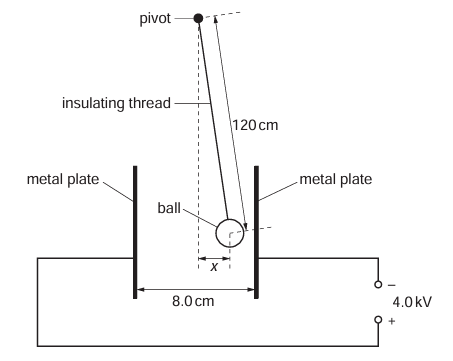
- A ball coated with conducting paint has weight 0.030 N and radius 1.0 cm. The ball is suspended from an insulating thread. The distance between the pivot and the centre of the ball is 120 cm.
- The ball is placed between two vertical metal plates. The separation between the plates is 8.0 cm. The plates are connected to a 4.0 kV power supply.
- (a) The ball receives a positive charge of 9.0 nC when it is made to touch the positive plate. It then repels from the positive plate and hangs in equilibrium at a displacement x from the vertical, as shown below. The diagram is not drawn to scale.
- i) Show that the electric force acting on the charged ball is [math]4.5 \times 10^{-4}\ \text{N}[/math].
- Explain:
- Electric Field Strength (E):
- The electric field between two parallel plates separated by distance
- [math]d = 8.0\ \text{cm} = 0.080\ \text{m}[/math]
- connected to potential difference
- [math]V = 4.0\ \text{kV} = 4000\ \text{V}[/math]
- is given by:
- [math]E = \dfrac{V}{d}[/math]
- [math]=\dfrac{4000\ \text{V}}{0.080\ \text{m}} = 50000\ \text{V m}^{-1}[/math]
- Electric Force ([math]F_E[/math]):
- The force exerted on charge
- [math]Q = 9.0\ \text{nC} = 9.0 \times 10^{-9}\ \text{C}[/math]
- is:
- [math]F_E = Q \cdot E = (9.0 \times 10^{-9}\ \text{C}) \times (50000\ \text{V m}^{-1})[/math]
- [math]= 4.5 \times 10^{-4}\ \text{N}[/math]
- ii) Draw, on the diagram above, arrows which represent the three forces acting on the ball. Label each arrow with the name of the force it represents.
- Explain:
- The three forces acting on the ball in equilibrium are:
- Weight (W):
- Directed vertically downwards from the centre of the ball (0.030 N).
- Electric Force ([math]\boldsymbol{F_E}[/math]):
- Directed horizontally to the left, away from the positive plate ([math]4.5 \times 10^{-4}\ \text{N}[/math]).
- Tension (T):
- Directed along the insulating thread towards the pivot point.
- iii) By taking moments about the pivot, or otherwise, show that x = 1.8 cm.
- Explain:
- Taking moments about the pivot in equilibrium (or using force triangle / vector equilibrium):
- [math]\tan(\theta) = \dfrac{Opposite}{Adjacent}[/math]
- [math]=\dfrac{F_E}{W}[/math]
- For small angular displacements [math]\theta[/math]:
- [math]\tan(\theta) \approx \sin(\theta)[/math]
- [math]=\dfrac{x}{L}[/math]
- where
- [math]L = 120\ \text{cm} = 1.2\ \text{m}[/math]
- is the thread length from pivot to the centre of the ball.
- [math]\dfrac{x}{L} = \dfrac{F_E}{W}[/math]
- [math]x = L \times \left(\dfrac{F_E}{W}\right) = 120\ \text{cm} \times \dfrac{4.5 \times 10^{-4}\ \text{N}}{0.030\ \text{N}}[/math]
- [math]x = 120\ \text{cm} \times 0.015 = 1.8\ \text{cm}[/math]
- b) The ball is still positively charged.
- The plates are now moved slowly towards each other whilst still connected to the 4.0 kV power supply. The plates are stopped when the separation is 5.0 cm.
- Explain the effect that this has on the deflection of the ball and explain why the ball eventually starts to oscillate between the plates.
- Explain:
- Effect on Deflection:
- As plate separation d decreases from 8.0 cm to 5.0 cm while V remains constant (4.0 kV), the electric field strength [math]E = \dfrac{V}{d}[/math] increases. Consequently, the electric force [math]F_E = QE[/math] increases, causing the horizontal deflection x of the ball to increase.
- Why Oscillation Begins:
- As x increases, the ball eventually touches the negative plate. Upon contact:
- The positively charged ball transfers its positive charge to the negative plate and acquires a negative charge.
- It is immediately repelled by the negative plate and attracted towards the positive plate.
- When it reaches and touches the positive plate, it discharges, acquires a positive charge again, and is repelled back toward the negative plate.
- This continuous charge transfer and reversal of electric force creates sustained mechanical oscillations between the plates.
- c) When the ball oscillates between the plates, the current in the external circuit is 3.2 × 10⁻⁸ A.
- A charge of 9.0 nC moves across the gap between the plates each time the ball makes one complete oscillation.
- Calculate the frequency f of the oscillations of the ball.
- Explain:
- Charge transferred per second (Current I):
- [math]I = 3.2 \times 10^{-8}\ \text{A}[/math]
- Charge transferred per complete cycle ([math]\Delta Q[/math]):
- Each complete oscillation involves moving across the gap twice (to exchange charge at both plates), resulting in total charge transfer
- [math]\Delta Q = 2 \times 9.0\ \text{nC} = 1.8 \times 10^{-8}\ \text{C}\ per\ cycle.[/math]
- Frequency Formula:
- [math]I = f \cdot \Delta Q[/math]
- [math]f = \dfrac{I}{\Delta Q}[/math]
- Calculation:
- [math]f = \dfrac{3.2 \times 10^{-8}\ \text{A}}{1.8 \times 10^{-8}\ \text{C}} \approx 1.78\ \text{Hz}[/math]
- 2. The diagram below shows a circuit containing two capacitors which are both initially uncharged.
- The battery has e.m.f. E and negligible internal resistance.
- The switch S is first moved to position A until the capacitor of capacitance C0 is fully charged.
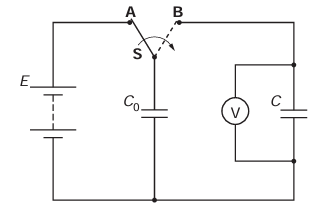
- The switch S is then moved to position B. The initial charge stored by the capacitor of capacitance C0 is shared between the two capacitors.
- The final reading on the voltmeter is V.
- a) Show that
- [math]V = \dfrac{C_0}{C + C_0}E[/math]
- Explain:
- Initial State (Switch at A):
- When the switch is moved to position A, the capacitor [math]C_0[/math] charges up to the battery’s e.m.f., E.
- The total initial charge stored on [math]\boldsymbol{C_0}[/math] is:
- [math]Q = C_0E[/math]
- Final State (Switch moved to B):
- When the switch is moved to position B, $C_0$ is connected in parallel with the uncharged capacitor C. The initial charge Q is shared between both capacitors until they reach a common potential difference V. The total charge stored by the combination is:
- [math]Q = Q_0 + Q_C = C_0V + CV = (C + C_0)V[/math]
- Applying Conservation of Charge:
- Equating the total charge before and after switching:
- [math]C_0E = (C + C_0)V[/math]
- Rearranging for V:
- [math]V = \dfrac{C_0}{C + C_0}E[/math]
- b) A student wants to determine the values of E and C0 by repeating the experiment above and measuring the potential difference (p.d.) V for a selection of capacitors of capacitance C.
- The student decides to plot a graph of [math]\dfrac{1}{V}[/math] against C.
- (i) Use the expression in (a) to show that the graph should be a straight line of gradient [math]\dfrac{1}{C_0E}[/math] and y-intercept [math]\dfrac{1}{E}[/math]
- Explain:
- Showing the straight-line equation
- Starting from the expression in part (a):
- [math]V = \dfrac{C_0E}{C + C_0}[/math]
- Take the reciprocal of both sides:
- [math]\dfrac{1}{V} = \dfrac{C + C_0}{C_0E}[/math]
- Splitting the fraction:
- [math]\dfrac{1}{V} = \left(\dfrac{1}{C_0E}\right)C + \dfrac{C_0}{C_0E}[/math]
- [math]\dfrac{1}{V} = \left(\dfrac{1}{C_0E}\right)C + \dfrac{1}{E}[/math]
- Comparing this to the standard linear equation
- [math]y = mx + c:[/math]
- y-variable:
- [math]\dfrac{1}{V}[/math]
- [math]x-variable:[/math]
- C Gradient (m):
- [math]\dfrac{1}{C_0E}[/math]
- y-intercept (c):
- [math]\dfrac{1}{E}[/math]
- (ii) The data points, error bars and the line of best fit drawn by the student are shown in the graph below.
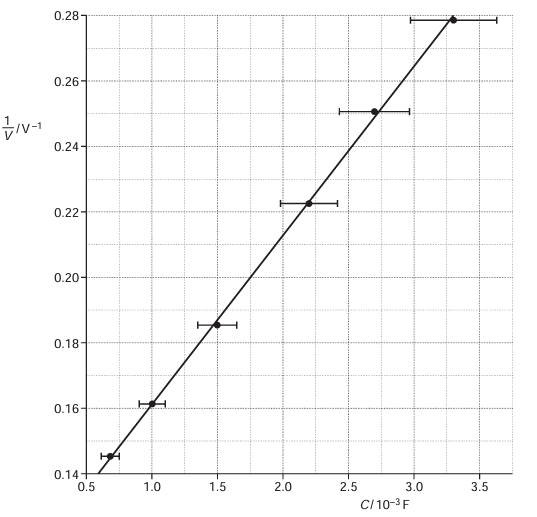
- The gradient of the line of best fit is 51 V–1 F–1. The value of E is 9.1 V.
- Determine the value of C0 in millifarads (mF). Write your answer to 2 significant figures.
- Explain:
- Determining C0 in millifarads (mF)
- 1. Relation from gradient:
- [math]Gradient = \dfrac{1}{C_0E}[/math]
- 2. Substitute given values:
- Gradient = 51 [math]V^{-1}F^{-1}[/math]
- E = 9.1 V
- [math]51 = \dfrac{1}{C_0 \times 9.1}[/math]
- 3. Solve for [math]C_0[/math]:
- [math]C_0 = \dfrac{1}{51 \times 9.1}[/math]
- [math]=\dfrac{1}{464.1}[/math]
- [math]\approx 2.1547 \times 10^{-3}\ \text{F}[/math]
- 4. Convert to millifarads (mF) to 2 significant figures:
- [math]C_0 = 2.2\ \text{mF}[/math]
- (iii) Draw on the graph a straight line of worst fit.
- Use this line to determine the absolute uncertainty in your value of C0. Write your answer to an appropriate number of significant figures.
- Explain:
- Drawing the Worst Fit Line:
- Identify the extreme error bars:
- First point error bar:
- [math]C \approx (0.7 \pm 0.1) \times 10^{-3}\ \text{F}[/math]
- at
- [math]\dfrac{1}{V} = 0.145\ V^{-1}[/math]
- Top point error bar:
- [math]C \approx (3.3 \pm 0.3) \times 10^{-3}\ \text{F}[/math]
- at
- [math]\dfrac{1}{V} = 0.278\ V^{-1}.[/math]
- Draw a straight line passing through the opposite extreme limits of the error bars (e.g., from the top-left of the lowest error bar to the bottom-right of the highest error bar, or vice versa).
- Calculating the Worst Gradient:
- Pick two distant points on your line of worst fit [math](x_1, y_1)\ and\ (x_2, y_2)[/math]:
- [math]Gradient_{worst} = \dfrac{y_2 – y_1}{x_2 – x_1}[/math]
- (A typical acceptable worst-fit line on this standardized graph yields a gradient between
- [math]45\ V^{-1}F^{-1}[/math]
- and
- [math]57\ V^{-1}F^{-1}[/math]
- Determining [math]C_{0,worst}[/math]:
- [math]C_{0,worst} = \dfrac{1}{Gradient_{worst} \times E}[/math]
- Calculating Absolute Uncertainty:
- [math]Absolute\ Uncertainty = |C_0 – C_{0,worst}|[/math]
- c) The experiment is repeated with a resistor of resistance 10 kΩ placed in series between S and the capacitor of capacitance C0.
- State with a reason what effect, if any, this would have on the experiment.
- Explain:
- Effect: No effect on the final reading V or the final shared charge distribution.
- Reason: Adding a resistor increases the time constant ([math]\tau = RC[/math]) of the circuit, meaning it takes longer for the capacitors to fully charge and share their charge. However, once equilibrium is reached, no current flows, so the final potential difference V across the capacitors remains identical.
- 3. This question is about the Sun and its radiation.
- (a) .
- (i) Use the data below to show that the luminosity of the Sun is about 4 × 1026 W.
- – radius of Sun = [math]7.0 \times 10^{8}\ \text{m}[/math]
- – surface temperature of Sun = 5800 K
- Explain:
- Calculation of the Sun’s Luminosity
- The luminosity L of a star modelled as a black-body radiator is given by the Stefan-Boltzmann law:
- [math]L = 4\pi R^2 \sigma T^4[/math]
- Given:
- Radius of the Sun,
- [math]R_{\odot} = 7.0 \times 10^{8}\ \text{m}[/math]
- Surface temperature of the Sun,
- [math]T_{\odot} = 5800\ \text{K}[/math]
- Stefan-Boltzmann constant,
- [math]\sigma \approx 5.67 \times 10^{-8}\ \text{W m}^{-2}\text{K}^{-4}[/math]
- Calculation:
- [math]L_{\odot} = 4\pi(7.0 \times 10^{8})^2 \times (5.67 \times 10^{-8}) \times (5800)^4[/math]
- [math]L_{\odot} = 4\pi(4.9 \times 10^{17}) \times (5.67 \times 10^{-8}) \times (1.1316 \times 10^{15})[/math]
- [math]L_{\odot} \approx 3.95 \times 10^{26}\ \text{W} \approx 4 \times 10^{26}\ \text{W}[/math]
- Explanation:
- The Stefan-Boltzmann law states that power emitted per unit surface area is proportional to the fourth power of absolute temperature ([math]\sigma T^4[/math]). Multiplying by the surface area of a sphere ([math]4\pi R^2[/math]) gives the total radiated energy per second (luminosity L).
- (ii) Sirius, the brightest star in the night sky, has a luminosity 25 times greater than that of the Sun. It has diameter 1.7 times greater than that of the Sun. Calculate the surface temperature T of Sirius
- Explain:
- Surface Temperature of Sirius
- Given:
- [math]L_{Sirius} = 25\ L_{\odot}[/math]
- Diameter factor = 1.7,
- so radius
- [math]R_{Sirius} = 1.7\ R_{\odot}[/math]
- Using the ratio of Stefan-Boltzmann law equations:
- [math]\dfrac{L_{Sirius}}{L_{\odot}} = \left(\dfrac{R_{Sirius}}{R_{\odot}}\right)^2 \times \left(\dfrac{T_{Sirius}}{T_{\odot}}\right)^4[/math]
- Substitute the given ratios into the equation:
- [math]25 = (1.7)^2 \times \left(\dfrac{T_{Sirius}}{5800}\right)^4[/math]
- [math]25 = 2.89 \times \left(\dfrac{T_{Sirius}}{5800}\right)^4[/math]
- [math]\left(\dfrac{T_{Sirius}}{5800}\right)^4 = \dfrac{25}{2.89}[/math]
- [math]\approx 8.6505[/math]
- [math]\dfrac{T_{Sirius}}{5800} = (8.6505)^{1/4}[/math]
- [math]\approx 1.7148[/math]
- [math]T_{Sirius} = 5800 \times 1.7148 \approx 9946\ \text{K}[/math]
- [math]or\ 9900\ \text{K}\ to\ 2\ significant\ figures[/math]
- Explanation:
- Because Sirius has a larger radius, its increased surface area contributes to a higher luminosity. By accounting for the area factor ([math]1.7^2[/math]), the remaining increase in luminosity must be supplied by a higher surface temperature, which scales with the fourth root of luminosity per unit area.
- (b) A student attends a lecture about the Sun and makes the following notes.
- The Sun loses more than 4 × 10⁹ kg of its mass every second to maintain its luminosity.
- Treating hydrogen nuclei (protons) as an ideal gas, a temperature of 1010 K provides a kinetic energy of about 1 MeV, which is necessary for fusion.
- However, the Sun’s core temperature is only 107 K, so the chance of protons fusing on collision is very small. This explains why the Sun has such a long lifetime.
- Explain the principles of physics which are involved in each of the three points. You should include relevant formulae, but no numbers or calculations are required.
- Explain:
- 1. Mass Loss and Luminosity
- Mass-Energy Equivalence:
- The primary physical principle is Einstein’s mass-energy relation:
- [math]E = \Delta m \cdot c^2[/math]
- [math]or[/math]
- [math]L = \dfrac{\Delta m}{\Delta t}c^2[/math]
- Mechanism:
- In the core of the Sun, hydrogen nuclei undergo nuclear fusion to form helium. The combined mass of the resulting helium nucleus is slightly less than the total mass of the initial hydrogen protons. This mass defect ([math]\Delta m[/math]) is directly converted into energy released as radiation, providing the total power output (luminosity L).
- 2. Temperature and Kinetic Energy Required for Fusion
- Ideal Gas Kinetic Energy:
- According to kinetic theory, the average thermal kinetic energy [math]E_k[/math] of gas particles at absolute temperature T is given by:
- [math]E_k = \dfrac{3}{2}k_BT[/math]
- Electrostatic (Coulomb) Repulsion:
- Protons are positively charged, so they experience a repulsive electrostatic force described by Coulomb’s law:
- [math]F = \dfrac{q_1q_2}{4\pi\varepsilon_0r^2}[/math]
- Mechanism:
- For two protons to fuse, they must overcome this electrostatic barrier and get close enough (on the order of [math]10^{-15}\ \text{m}[/math]) for the attractive strong nuclear force to dominate. Classical physics requires high thermal kinetic energies (~ 1 MeV), which corresponds to temperatures around [math]10^{10}\ \text{K}[/math].
- 3. Core Temperature and Long Lifetime
- Maxwell-Boltzmann Distribution:
- At the core temperature of [math]10^7\ \text{K}[/math], the average kinetic energy of protons is well below the classical Coulomb barrier (~1 keV vs. 1 MeV).
- However, particle energies follow a Maxwell-Boltzmann distribution, meaning only an extremely small fraction of protons possess kinetic energy in the high-energy tail of the curve.
- Quantum Mechanical Tunneling:
- Protons can undergo quantum tunneling through the electrostatic potential energy barrier even when their kinetic energy is lower than the peak height of the barrier.
- Low Probability & Fusion Rate:
- Because the probability of overcoming or tunneling through the barrier at [math]10^7\ \text{K}[/math] is exceedingly small, fusion events occur very infrequently per individual proton collision. This extremely low rate of nuclear reaction prevents the Sun from consuming its hydrogen fuel rapidly, thereby ensuring a stable, multi-billion-year lifespan.
- 4. The International Space Station (ISS) orbits the Earth at a height of [math]4.1 \times 10^{5}\ \text{m}[/math] above the Earth’s surface.
- The radius of the Earth is [math]6.37 \times 10^{6}\ \text{m}[/math]. The gravitational field strength g0 at the Earth’s surface is 9.81 N kg–1.
- (a) Both the ISS and the astronauts inside it are in free fall. Explain why this makes the astronauts feel weightless.
- Explain:
- Height of ISS above Earth’s surface (h): [math]4.1 \times 10^5\ \text{m}[/math]
- Radius of Earth ([math]r_E[/math]): [math]6.37 \times 10^6\ \text{m}[/math]
- Surface gravitational field strength ([math]g_0[/math]): [math]9.81\ \text{N kg}^{-1}[/math]
- Speed of ISS ([math]v_{orbital}[/math]): [math]7.7\ \text{km s}^{-1} = 7700\ \text{m s}^{-1}[/math]
- Molar mass of air (M): [math]2.9 \times 10^{-2}\ \text{kg mol}^{-1}[/math]
- Temperature of air (T): [math]20^{\circ}\text{C} = 293.15\ \text{K}[/math]
- (a) Explanation of Weightlessness
- Both the ISS and the astronauts inside it accelerate toward the center of the Earth at the exact same rate under the influence of gravity alone. Because there is no relative motion or contact force between the astronauts and the structure of the space station, the normal contact force acting on the astronauts is zero (N = 0). Since our sensation of weight is provided by the normal reaction force pushing back against us, feeling no contact force produces the sensation of weightlessness.
- (b) .
- i) Calculate the value of the gravitational field strength g at the height of the ISS above the Earth.
- Explain:
- Calculating Gravitational Field Strength (g) at ISS Altitude
- The gravitational field strength follows an inverse-square law with respect to distance r from the center of the Earth:
- [math]g = \dfrac{GM}{r^2}[/math]
- Since
- [math]g_0 = \dfrac{GM}{r_E^2}[/math]
- we can write g as:
- [math]g = g_0\left(\dfrac{r_E}{r_E + h}\right)^2[/math]
- Calculate total orbital radius r:
- [math]r = r_E + h[/math]
- [math]=6.37 \times 10^6\ \text{m} + 0.41 \times 10^6\ \text{m}[/math]
- [math]=6.78 \times 10^6\ \text{m}[/math]
- Substitute values:
- [math]g = 9.81 \times \left(\dfrac{6.37 \times 10^6}{6.78 \times 10^6}\right)^2[/math]
- [math]g = 9.81 \times (0.93953)^2[/math]
- [math]\approx 8.66\ \text{N kg}^{-1}[/math]
- Answer:
- [math]g \approx 8.66\ \text{N kg}^{-1}\ (or\ \text{m s}^{-2})[/math]
- ii) The speed of the ISS in its orbit is 7.7 km s–1. Show that the period of the ISS in its orbit is about 90 minutes.
- Explain:
- Orbital Period (T) of the ISS
- For a circular orbit of radius r and speed v:
- [math]v = \dfrac{2\pi r}{T}[/math]
- [math]T = \dfrac{2\pi r}{v}[/math]
- Substitute values:
- [math]T = \dfrac{2\pi \times 6.78 \times 10^6\ \text{m}}{7700\ \text{m s}^{-1}}[/math]
- [math]\approx 5532\ \text{seconds}[/math]
- Convert to minutes:
- [math]T = \dfrac{5532}{60}[/math]
- [math]\approx 92.2\ \text{minutes}[/math]
- Thus, the orbital period is about 90 minutes.
- (c) Use the information in (b)(ii) and the data below to show that the root mean square (r.m.s.) speed of the air molecules inside the ISS is approximately 15 times smaller than the orbital speed of the ISS.
- – molar mass of air = [math]2.9 \times 10^{-2}\ \text{kg mol}^{-1}[/math]
- – temperature of air inside the ISS = 20 °C
- Explain:
- The r.m.s. speed of ideal gas molecules is given by:
- [math]c_{rms} = \sqrt{\dfrac{3RT}{M}}[/math]
- [math]R = 8.314\ \text{J K}^{-1}\text{mol}^{-1}\ (ideal\ gas\ constant)[/math]
- [math]T = 20 + 273.15 = 293.15\ \text{K}[/math]
- [math]M = 2.9 \times 10^{-2}\ \text{kg mol}^{-1}[/math]
- Calculate [math]c_{rms}[/math]:
- [math]c_{rms} = \sqrt{\dfrac{3 \times 8.314 \times 293.15}{2.9 \times 10^{-2}}}[/math]
- [math]=\sqrt{\dfrac{7312.18}{0.029}}[/math]
- [math]=\sqrt{252144.14}[/math]
- [math]\approx 502.1\ \text{m s}^{-1}[/math]
- Compare with orbital speed
- [math](v_{orbital} = 7700\ \text{m s}^{-1}):[/math]
- [math]\dfrac{v_{orbital}}{c_{rms}} = \dfrac{7700}{502.1}[/math]
- [math]\approx 15.3[/math]
- Since 15.3 ≈ 15, the r.m.s. speed of the air molecules is indeed approximately 15 times smaller than the orbital speed of the ISS.