
OCR A Physics OCR Paper 1 2025

- Section A
- You should spend a maximum of 30 minutes on this section.
- 1. Write your answer to each question in the box provided.
- Which component of a gamma camera absorbs gamma rays and produces visible light? (1)
- A. collimator
- B. computer
- C. photomultiplier tube
- D. scintillator
- Result: D
- Explanation:
- The scintillator crystal (usually sodium iodide) absorbs incoming gamma rays and converts their energy into visible light photons.
- These light photons are then detected and amplified by photomultiplier tubes.
- 2. What is a reasonable estimate for the diameter of an atom? (1)
- A. [math]10^{-15}\mathrm{m}[/math]
- B. [math]10^{-12}\mathrm{m}[/math]
- C. [math]10^{-10}\mathrm{m}[/math]
- D. [math]10^{-7}\mathrm{m}[/math]
- Result: C
- Explanation:
- Typical atomic diameters are about 0.1 nm.
- [math]0.1\mathrm{nm}=1\times10^{-10}\mathrm{m}[/math]
- Therefore [math]10^{-10}\mathrm{m}[/math] is the best estimate.
- 3. The graph below shows the binding energy per nucleon, E, for nuclei of different nucleon number, A.
- Which of the following statement(s) correctly describe nuclear processes? (1)
- 1- Fission of nuclei to the right of X releases energy
- 2- Fusion of nuclei to the left of X releases energy
- 3- Fission of nuclei to the right of X can happen spontaneously
- A. Only 1
- B. Only 2
- C. Only 2 and 3
- D. 1, 2 and 3
- Result: D
- Explanation:
- – Nuclei to the right of X are heavy nuclei.They release energy by fission.
- – Nuclei to the left of X are light nuclei.They release energy by fusion.
- – Some very heavy nuclei can undergo spontaneous fission.
- Therefore, all three statements are correct.
- The current in a copper wire of radius [math]2.5\times10^{-4}\mathrm{m}[/math] is [math]1.4\mathrm{A}[/math]. (1)
- The number density of charge carriers (electrons) in copper is [math]8.5\times10^{28}\mathrm{m^{-3}}[/math].
- 4. What is the mean drift velocity of the electrons in the wire?
- A. [math]2.1\times10^{-4}\mathrm{mms^{-1}}[/math]
- B. [math]0.13\mathrm{mms^{-1}}[/math]
- C. [math]0.52\mathrm{mms^{-1}}[/math]
- D. [math]1.9\mathrm{mms^{-1}}[/math]
- Result: C
- Explanation:
- Mean Drift Velocity of Electrons:
- Given data:
- [math]I=1.4\mathrm{A}[/math]
- [math]r=2.5\times10^{-4}\mathrm{m}[/math]
- [math]n=8.5\times10^{28}\mathrm{m^{-3}}[/math]
- [math]e=1.6\times10^{-19}\mathrm{C}[/math]
- Using formula:
- [math]I=nAev_d[/math]
- Area:
- [math]A=\pi r^2[/math]
- [math]A=\pi(2.5\times10^{-4})^2[/math]
- [math]A=1.96\times10^{-7},\mathrm{m^2}[/math]
- [math]v_d=\frac{I}{nAe}[/math]
- [math]v_d=\frac{1.4}{(8.5\times10^{28})(1.96\times10^{-7})(1.6\times10^{-19})}[/math]
- [math]v_d=5.2\times10^{-4}\mathrm{ms^{-1}}[/math]
- [math]v_d=0.52\mathrm{mms^{-1}}[/math]
- 5. An isotope has a half-life of 243 years. (1)
- One sample of this isotope has activity [math]A_1[/math].
- A second sample of the same isotope has activity [math]A_2[/math].
- What is the ratio = [math]\frac{\text{mass of isotope in first sample}}{\text{mass of isotope in second sample}}=?[/math]
- A. [math]\frac{243A_1}{A_2}[/math]
- B. [math]\frac{A_1}{243}[/math]
- C. [math]\frac{A_1}{A_2}[/math]
- D. [math]\frac{A_2}{243}[/math]
- Result: C
- Explanation:
- [math]\frac{\text{mass of first sample}}{\text{mass of second sample}}=\frac{A_1}{A_2}[/math]
- Solution:
- For the same isotope:
- [math]A=\lambda N[/math]
- Since [math]\lambda[/math] is constant,
- [math]A\propto N[/math]
- And
- [math]N\propto\text{mass}[/math]
- Therefore,
- [math]\frac{m_1}{m_2}=\frac{A_1}{A_2}[/math]
- 6. A student wants to determine the count-rate from a beta-emitting source in the laboratory. Which procedure would be the best to determine the count-rate? (1)
- A. Measure the counts over a long period of time
- B. Place the radiation detector (Geiger tube) about 1 metre away from the source
- C. Place the source close to a very strong magnet
- D. Place the source inside a lead box when measuring the counts
- Result: A
- Explanation:
- Radioactive decay is random. Measuring for a long time reduces percentage uncertainty and gives a more accurate count rate.
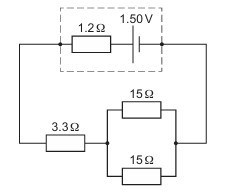
- 7. A cell has electromotive force (e.m.f.) 1.50 V and internal resistance 1.2 Ω. It is connected in a circuit as shown below.
- What is the terminal potential difference (p.d.) of the cell in this circuit? (1)
- A. 0.15 V
- B. 1.35 V
- C. 1.50 V
- D. 1.65 V
- Result: B
- Explanation:
- Cell with internal resistance:
- Given Data:
- [math]E=1.50\text{V}[/math]
- [math]r=1.2\Omega[/math]
- (From the circuit, the current is 0.125 A.)
- Terminal P.d:
- [math]V=E-Ir[/math]
- [math]V=1.50-(0.125)(1.2)[/math]
- [math]V=1.35\text{V}[/math]
- Terminal potential difference equals emf minus the lost volts inside the cell.
- 8. A student uses a tube closed at one end to determine the speed of sound. A stationary wave is formed within the tube.
- Which of the following quantities can be used to determine the speed of sound in air? (1)
- A. length of air column in tube, number of antinodes
- B. length of air column in tube, fundamental frequency
- C. number of nodes, number of antinodes
- D. number of nodes, resonant frequency.
- Result: B
- Explanation:
- For a tube closed at one end:
- [math]L=\frac{\lambda}{4}[/math]
- Thus,
- [math]v=f\lambda[/math]
- Knowing the air-column length and resonant frequency allows the wavelength and speed to be calculated.
- 9. The radius R of the nucleus of an unknown isotope with nucleon number A is calculated using the formula
- [math]R=r_0A^{\frac{1}{3}}[/math]
- Where [math]r_0[/math] is a constant.
- The percentage uncertainty in [math]r_0[/math] is ±5%
- The percentage uncertainty in A is ±3%
- What is the percentage uncertainty in R? (1)
- A. ±2%
- B. ±4%
- C. ±6%
- D. ±8%
- Result: C
- Explanation:
- Percentage Uncertainty in Nuclear Radius:
- [math]R=r_0A^{\frac{1}{3}}[/math]
- For multiplication:
- [math]\text{%}\Delta R=\text{%}\Delta r_0+\frac{1}{3}(\text{%}\Delta A)[/math]
- [math]\text{%}\Delta R=5+\frac{1}{3}(3)[/math]
- [math]\text{%}\Delta R=5+1[/math]
- [math]\text{%}\Delta R=6\text{%}[/math]
- For powers, multiply the percentage uncertainty by the power.
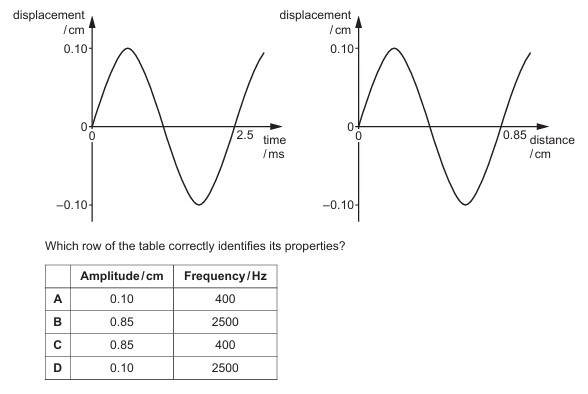
- 10. The diagrams show representations of a progressive wave. (1)
- Result: A
- Explanation:
- From the displacement time graph:
- [math]\text{Amplitude}=\text{maximum displacement from equilibrium}[/math]
- The Maximum displacement is
- [math]A=0.10\text{m}[/math]
- Now find the frequency:
- From the graph one complete cycle takes:
- [math]T=2.5\text{ms}=2.5\times10^{-3}\text{s}[/math]
- [math]f=\frac{1}{T}[/math]
- [math]f=\frac{1}{2.5\times10^{-3}}[/math]
- [math]f=400\text{Hz}[/math]
- 11. A proton with kinetic energy [math]1.6\times10^{-17}\text{J}[/math] is travelling at right angles to a magnetic field. The magnetic flux density is [math]0.050\text{T}[/math].
- What is the magnitude of the force on the proton? (1)
- A. [math]8.0\times10^{-19}\text{N}[/math]
- B. [math]1.1\times10^{-15}\text{N}[/math]
- C. [math]2.8\times10^{-6}\text{N}[/math]
- D. [math]6900\text{N}[/math]
- Result: B
- Explanation:
- [math]K.E=1.6\times10^{-17}\text{J}[/math]
- [math]B=0.050\text{T}[/math]
- [math]q=1.6\times10^{-19}\text{C}[/math]
- First find velocity:
- [math]K.E=\frac{1}{2}mv^2[/math]
- [math]v=\sqrt{\frac{2K.E}{m}}[/math]
- [math]v=\sqrt{\frac{2(1.6\times10^{-17})}{1.67\times10^{-27}}}[/math]
- [math]v=\sqrt{\frac{2(1.6\times10^{-17})}{1.67\times10^{-27}}}[/math]
- [math]v\approx1.38\times10^5\text{m/s}[/math]
- Magnetic force:
- [math]F=qvB[/math]
- [math]F=(1.6\times10^{-19})(1.38\times10^5)(0.050)[/math]
- [math]F=1.1\times10^{-15}[/math]
- Since motion is at right angles to the magnetic field,
- 12. The intensity of the Sun’s radiation at the surface of the Earth is 1400 [math]\text{W}\text{m}^{-2}[/math].
- The distance between the centre of the Sun and the surface of the Earth is [math]1.5\times10^8\text{km}[/math]. How much mass is converted into radiant energy in the Sun in one second? (1)
- A. [math]3.5\times10^8\text{kg}[/math]
- B. [math]1.1\times10^9\text{kg}[/math]
- C. [math]4.4\times10^9\text{kg}[/math]
- D. [math]1.3\times10^{18}\text{kg}[/math]
- Result: B
- Explanation:
- Mass Converted into Energy in the Sun per Second
- Given:
- [math]I=1400\text{W}\text{m}^{-2}[/math]
- [math]r=1.5\times10^{11}\text{m}[/math]
- Total power emitted:
- [math]P=4\pi r^2I[/math]
- [math]P=4\pi(1.5\times10^{11})^2(1400)[/math]
- [math]P=3.96\times10^{26}\text{W}[/math]
- Using:
- [math]E=mc^2[/math]
- [math]m=\frac{P}{c^2}[/math]
- [math]m=\frac{3.96\times10^{26}}{(3.0\times10^8)^2}[/math]
- [math]m=4.4\times10^9\text{kg}[/math]
- The Sun converts about 4.4 billion kilograms of mass into radiant energy every second.
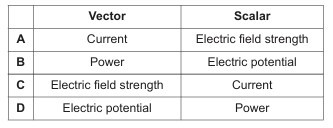
- 13. Some physical quantities are scalars and some are vectors. Which row of the table is correct? (1)
- Result: C
- Explanation:
- Electric Field Strength
- Electric field strength has both magnitude and direction, so it is a vector quantity.
- [math]E=\frac{F}{q}[/math]
- Since force F is a vector, electric field strength is also a vector.
- Current:
- Electric current is a scalar quantity. Although current flows in a particular direction through a circuit, it does not obey the rules of vector addition and is therefore treated as a scalar.
- [math]I=\frac{Q}{t}[/math]
- Charge and time are scalers, so current is treated as a scaler quantity.
- Electric field strength is a vector quantity because it has both magnitude and direction. Current is a scalar quantity because it does not obey vector addition rules. Therefore, Row C is the correct classification.
- 14. Many types of charged particles can be created in particle accelerators. The charge on an unknown particle is measured in four different experiments. Which experimental result for the charge on the particle is impossible? (1)
- A. [math]1.6\times10^{-19}\text{C}[/math]
- B. [math]2.1\times10^{-19}\text{C}[/math]
- C. [math]6.4\times10^{-19}\text{C}[/math]
- D. [math]9.6\times10^{-19}\text{C}[/math]
- Result: B
- Explanation:
- Charge on an Unknown Particle:
- Possible charges must be whole-number multiples of the elementary charge:
- [math]e=1.6\times10^{-19}\text{C}[/math]
- [math]2.1\times10^{-19}=1.3125e[/math]
- Charge is quantized and must be an integer multiple of [math]1.6\times10^{-19}\text{C}[/math]
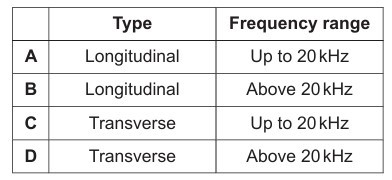
- 15. Ultrasound scanning uses waves of a particular type and frequency. Which row of the table is correct for these waves? (1)
- Result: B
- Explanation:
- The correct row – longitudinal mechanical wave, frequency greater than 20 kHz
- Ultrasound is a longitudinal mechanical wave. It has a frequency above the upper limit of human hearing.
- [math]f>20,000\text{Hz}[/math]
- Medical ultrasound usually uses frequencies in MHz range.
- Section B
- 16. A student is investigating the behaviour of a light-emitting diode (LED). They use the circuit below to determine the lowest potential difference (p.d.) at which the LED lights.
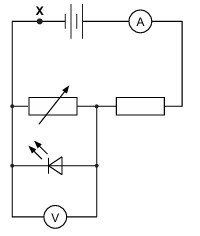
- (a) State the name of the circuit arrangement of the battery, variable resistor and resistor in this circuit. (1)
- Explanation:
- The battery, variable resistor and fixed resistor are connected in a single loop with no branches between them, so they form a series circuit.
- (b) Draw an arrow on the circuit to show the direction of conventional current.
- Explanation:
- Conventional current flows from the positive terminal of the battery (longer line) to the negative terminal (shorter line). In this circuit the current travels clockwise around the loop.
- (c) State how the readings on the ammeter and the voltmeter change when the resistance of the variable resistor is increased.
- Ammeter reading Decreases
- Voltmeter reading Increases
- Explanation:
- When the resistance of the variable resistor is increased:
- – The total resistance of the circuit increases.
- – The current in the series circuit decreases.
- Therefore:
- Ammeter reading decreases
- Because the variable resistor and LED are connected
- (d) The LED is made from two semiconducting materials. Compare the number density of charge carriers in semiconductors, metals and insulators. (2)
- Explanation:
- Free charge carriers are responsible for electrical conduction.
- [math]\text{Metals}>\text{Semiconductors}>\text{Insulators}[/math]
- in terms of number density of charge carriers.
- Final Mark-Scheme Style Answers
- (a) Series circuit
- (b) Clockwise (from positive to negative terminal)
- (e) This question is about a clockwise circuit loop starting at X.
- This loop is shown beneath the graph.
- Assume the battery has negligible internal resistance. The resistance of the ammeter is also negligible.
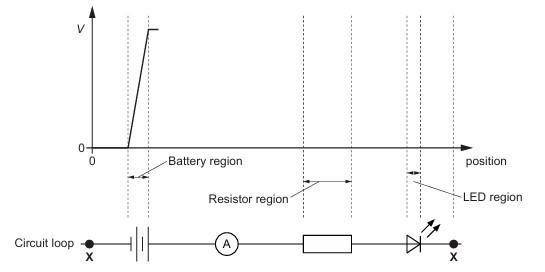
- On the axes above this loop, complete the graph to show the variation of the potential difference V relative to the point X with the position along this loop.
- Explanation:
- The graph shows how the potential difference (V) changes as we move clockwise around the circuit starting from X.
- Starting Point X:
- The question states that the potential difference is measured relative to point X.
- Therefore, at the starting point:
- [math]V=0\text{V}[/math]
- The graph begins at the origin.
- Across the Battery
- As we move through the battery from the negative terminal to the positive terminal, the battery supplies energy to the charges.
- This causes a rise in electric potential.
- Therefore, the graph shows a steep upward jump (already drawn on the graph).
- The battery is assumed to have negligible internal resistance, so the rise occurs almost instantaneously.
- Across the Ammeter
- The question states:
- “The resistance of the ammeter is negligible.”
- Using Ohm’s Law:
- [math]V=IR[/math]
- Since
- [math]R\approx0[/math]
- then
- [math]V\approx0[/math]
- There is essentially no voltage drop across the ammeter.
- Across the Resistor
- The resistor converts electrical energy into thermal energy.
- As charges pass through the resistor, they lose energy.
- Therefore, the potential difference decreases across the resistor.
- Using Ohm’s Law:
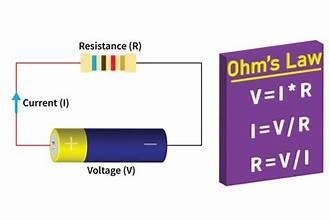
- Across the LED
- The LED is a semiconductor device.
- When current passes through it, electrical energy is converted into light energy.
- The LED requires a certain forward voltage before it emits light.
- As charges cross the LED, there is a significant drop in potential difference.
- Return to Point X:
- Kirchhoff’s Second Law states:
- The total emf supplied around a closed loop equals the total potential drops around the loop.
- Mathematically:
- [math]\Sigma V=0[/math]
- Therefore:
- [math]\text{Battery rise}=\text{Resistor drop}+\text{LED drop}[/math]
- When we arrive back at X:
- [math]V=0\text{V}[/math]
- The graph must finish on the horizontal axis.
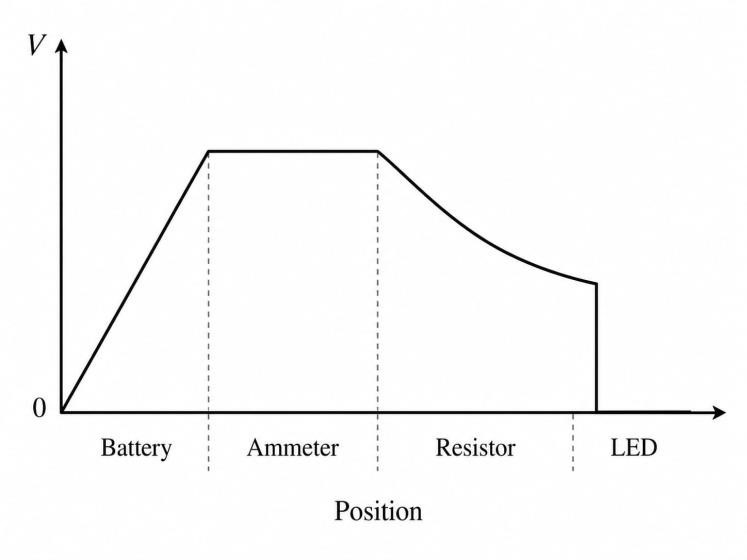
- Complete Description of the Graph
- Starting at X:
- 0 V
- Vertical rise across the battery
- Horizontal line across the ammeter
- Sloping downward line across the resistor
- Vertical drop across the LED
- Ends at 0 V when returning to X
- Result:
- The graph rises across the battery, remains constant across the ammeter, falls uniformly across the resistor, then falls suddenly across the LED and finally returns to 0 V at point X.
- – The battery provides a rise in potential difference.
- – The ammeter has negligible resistance, so there is no potential drop across it.
- – The resistor causes a gradual potential drop because electrical energy is dissipated as heat.
- – The LED causes an additional potential drop as electrical energy is converted into light energy.
- – By Kirchhoff’s second law, the total voltage rise equals the total voltage drops, so the graph returns to 0 V at the end of the loop.
- 17. Wave-particle duality’ refers to the idea that:
- – particles, such as electrons, can show behaviour characteristic of waves
- – waves, such as visible light, can show behaviour characteristic of particles.
- Describe each model.
- Describe the experimental evidence that justifies the model.
- You do not need to describe in detail how the experiments are carried out.
- Explanation:
- Wave–particle duality is the idea that matter and electromagnetic radiation can behave both as particles and as waves.
- (a) Particles such as electrons can show wave behaviour
- Wave Model of Electrons
- According to quantum physics, electrons are not only particles but also possess wave-like properties. Each moving electron has an associated wavelength called the de Broglie wavelength.
- [math]\lambda=\frac{h}{p}[/math]
- Where:
- – [math]\lambda=\text{wavelength}[/math]
- – [math]h=\text{Planck’s constant}[/math]
- – [math]p=\text{momentum}[/math]
- Experimental Evidence
- The strongest evidence comes from electron diffraction experiments.
- – When a beam of electrons passes through a thin crystal (such as graphite), a diffraction pattern is produced.
- Diffraction is a property of waves, not classical particles.
- Therefore, electrons must possess wave properties.
- (b) Waves such as visible light can show particle behaviour
- Particle Model of Light
- Light consists of particles called photons.
- Each photon carries a discrete amount of energy:
- [math]E=hf[/math]
- Where,
- – E = Photon Energy
- – h = Planck Constant
- – f = frequency
- Experimental Evidence
- – The main evidence is the photoelectric effect.
- When light shines on a metal surface:
- – Electrons are emitted only if the light frequency is above a threshold value.
- -Increasing intensity alone cannot eject electrons if the frequency is too low.
- This can only be explained if light arrives in packets (photons).
- Therefore, light behaves as particles.
- 18. X-rays are used for diagnostic imaging in a hospital. The diagram shows the structure of an X-ray tube.
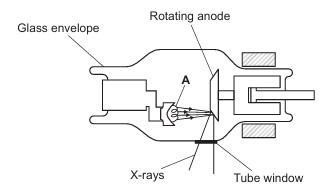
- (a) Name the component labelled A on the diagram. (1)
- Explanation:
- Component A is the heated filament located at the negative side of the tube.
- Its purpose is to emit electrons by thermionic emission.
- When heated:
- – Electrons gain energy.
- – Some escape from the metal surface.
- – These electrons are accelerated towards the anode.
- (b) Suggest why the anode is made to rotate. (1)
- Explanation:
- When high-speed electrons strike the anode:
- – Most of their kinetic energy becomes heat.
- – Less than 1% becomes X-rays.
- If the anode remained stationary:
- – One small area would become extremely hot.
- – The anode could melt or be damaged.
- Rotation spreads the heat over a larger surface area and increases the lifetime of the tube.
- (c) X-rays are produced at characteristic wavelengths which depend on the material of the anode. Describe how the electrons from component A are responsible for producing X-rays.
- Explanation:
- 1. The heated cathode emits electrons by thermionic emission.
- 2. A high potential difference accelerates the electrons towards the anode.
- 3. The electrons gain large kinetic energy.
- 4. When they strike the metal anode they are rapidly decelerated.
- 5. The loss of kinetic energy is emitted as X-ray photons.
- Two mechanisms produce X-rays:
- Bremsstrahlung Radiation
- – Electrons are slowed by nuclei in the target.
- – Energy lost is emitted as X-rays.
- – Produces a continuous spectrum.
- Characteristic X-rays
- – Incoming electrons knock out inner-shell electrons of the target atoms.
- – Electrons from higher energy levels fall into the vacancies.
- – Energy differences are emitted as X-ray photons.
- – The wavelengths depend on the target material.
- (d) An electron strikes the anode. The kinetic energy of the electron changes from 150 keV to 60 keV. Calculate the minimum wavelength, λ, of the X-ray photon emitted by the interaction of the electron with the anode. (2)
- [math]\lambda=\text{…………..m}[/math]
- Explanation:
- Initial energy:
- 150 keV
- Final energy:
- 60 keV
- Energy transferred:
- [math]E=150-60[/math]
- [math]E=90\text{keV}[/math]
- Convert to joules:
- [math]E=90\times10^3\times1.60\times10^{-19}[/math]
- [math]E=1.44\times10^{-14}\text{J}[/math]
- Use photon equation:
- [math]E=\frac{hc}{\lambda}[/math]
- Substituting:
- [math]\lambda=\frac{hc}{E}[/math]
- [math]\lambda=\frac{(6.63\times10^{-34})(3.00\times10^8)}{1.44\times10^{-14}}[/math]
- [math]\lambda=1.38\times10^{-11}\text{m}[/math]
- The shortest wavelength corresponds to the maximum photon energy.
- This occurs when all the energy lost by the electron becomes the energy of one X-ray photon
- (e) A radiologist targets a uniform beam of X-rays at a tumour 4.6 cm below the skin of a patient. The beam is at right angles to the surface of the skin.
- The intensity of the X-ray beam at the tumour is 30% of the incident intensity.
- Calculate the attenuation coefficient, μ, of the tumour tissue in [math]cm^–1[/math].
- [math]\mu=\text{……………………………………………}\text{cm}^{-1}[/math] (2)
- Explanation:
- – Depth = x = 4.6 cm
- – Intensity at tumour = [math]I=0.30I_0[/math]
- Use attenuation equation:
- [math]I=I_0e^{-\mu x}[/math]
- [math]0.30I_0=I_0e^{-4.6\mu}[/math]
- [math]0.30=e^{-4.6\mu}[/math]
- [math]\ln(0.30)=-4.6\mu[/math]
- [math]\mu=\frac{-\ln(0.30)}{4.6}[/math]
- [math]\mu=0.262\text{cm}^{-1}[/math]
- means the intensity decreases exponentially as the X-rays pass through the tumour tissue.
- 19. .
- (a) Describe the difference between hadrons and leptons.
- Explanation:
- Hadrons
- – Made from quarks.
- – Experience the strong nuclear force.
- – Examples:
o Proton (uuduuduud)
o Neutron (udduddudd)
o Mesons - Leptons
- – Fundamental particles (not made of smaller particles).
- – Do not experience the strong nuclear force.
- – Examples:
o Electron (e−e^-e−)
o Positron (e+e^+e+)
o Muon
o Neutrinos - Key Difference
-
Hadrons
Leptons
Made of quarks Not made of quarks Experience strong force Do not experience strong force - (b) An ‘up’ quark decays according to the equation below.
- [math]u\rightarrow d+{}^{0}_{+1}e+\nu[/math]
- Give the name(s) of the lepton(s) in this equation.
- Explanation:
- The particles in the equation are:
- – u = up quark
- – d = down quark
- – [math]{}^{0}_{+1}e[/math] = positron
- – ν = neutrino
- The leptons are:
- 1. Positron (e+)
- 2. Electron neutrino (νe)
- Both belong to the lepton family.
- (c) The above decay takes place within a nucleus of carbon-11. The half-life of this isotope of carbon is 1220 s.
- A sample of carbon-11 has an activity of 800 Bq.
- Calculate the activity, A, of this sample of carbon-11 after 5.0 minutes.
- A=…………………………………Bq (3)
- Explanation:
- Initial Activity = [math]A_0=800\text{Bq}[/math]
- Half Life = [math]t_{1/2}=1220\text{s}[/math]
- Time elapsed = 5.0 mint = 300 s
- Use Radioactive decay equation:
- [math]A=A_0\left(\frac{1}{2}\right)^{t/t_{1/2}}[/math]
- [math]A=800\left(\frac{1}{2}\right)^{300/1220}[/math]
- [math]A=800\left(\frac{1}{2}\right)^{0.246}[/math]
- [math]A=800(0.843)[/math]
- [math]A=674[/math]
- [math]A=6.7\times10^2\text{Bq}[/math]