
OCR A Physics OCR Paper 1 2022
-
SECTION A
-
You should spend a maximum of 30 minutes on this section.
-
Write your answer to each question in the box provided.
-
Answer all the questions.
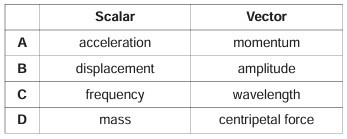
- 1. A student has constructed the table below of possible scalar and vector quantities.
- Answer: D
- Explain:
- – Mass is a scalar quantity because it only has magnitude, while centripetal force is a vector quantity because it has both magnitude and a specific direction (towards the center of the circular path).
- – In the other options, acceleration, displacement, and amplitude/wavelength are incorrectly categorized.
- 2. The diameter of a wire is measured in five different places along its length. The results are shown below.
- [math]1.92\ \text{mm}[/math]
- [math]1.88\ \text{mm}[/math]
- [math]1.90\ \text{mm}[/math]
- [math]1.86\ \text{mm}[/math]
- [math]1.89\ \text{mm}[/math]
- What is the absolute uncertainty in the diameter of this wire?
- A. [math]0.01\ \text{mm}[/math]
- B. [math]0.03\ \text{mm}[/math]
- C. [math]0.05\ \text{mm}[/math]
- D. [math]0.06\ \text{mm}[/math]
- Answer: B
- Explain:
- The absolute uncertainty of a repeated set of measurements can be estimated using half of the range:
- [math]\text{Absolute Uncertainty}=\frac{\text{Maximum Value}-\text{Minimum Value}}{2}[/math]
- [math]\text{Maximum Value}=1.92\ \text{mm}[/math]
- [math]\text{Minimum Value}=1.86\ \text{mm}[/math]
- [math]\text{Absolute Uncertainty}=\frac{1.92-1.86}{2}[/math]
- [math]\text{Absolute Uncertainty}=\frac{0.06}{2}[/math]
- [math]\text{Absolute Uncertainty}=0.03\ \text{mm}[/math]
- 3. A student has plotted a velocity against time graph for a trolley moving down a ramp.
- Which of the following pair of quantities can be determined from the gradient of the graph and the area under the graph?
- A. acceleration, displacement
- B. acceleration, impulse
- C. displacement, kinetic energy
- D. force, work done
- Answer: A
- Explain:
- – The gradient of a velocity-time graph represents the rate of change of velocity, which is acceleration.
- [math]a=\frac{\Delta x}{\Delta t}[/math]
- – The area under a velocity-time graph represents the product of velocity and time, which is displacement.
- [math]s=vt[/math]
- 4. The diagram below shows the directions and magnitudes of the three forces acting on an object at a specific time as it moves through water.
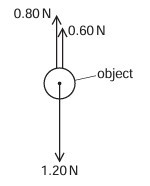
- The weight of the object is [math]1.20\ \text{N}[/math], the upthrust on the object is [math]0.80\ \text{N}[/math] and the drag is [math]0.60\ \text{N}[/math].
- Which statement is correct about this object at this specific time?
- A. It has reached its terminal velocity.
- B. It is accelerating.
- C. It is decelerating.
- D. It is moving upwards.
- Answer: C
- Explain:
- [math]\text{Total Upward Force}=\text{Upthrust}+\text{Drag}[/math]
- [math]\text{Total Upward Force}=0.80\ \text{N}+0.60\ \text{N}[/math]
- [math]\text{Total Upward Force}=1.40\ \text{N}[/math]
- [math]\text{Total Downward Force}=\text{Weight}[/math]
- [math]\text{Total Downward Force}=1.20\ \text{N}[/math]
- The net force is [math]1.40\ \text{N}-1.20\ \text{N}=0.20\ \text{N}[/math] directed upwards.
- – Since fluid drag always opposes the direction of motion and is pointing upwards, the object must currently be moving downwards.
- – Because the net force (upwards) opposes the direction of motion (downwards), the object is decelerating.
- 5. The object below is in equilibrium.
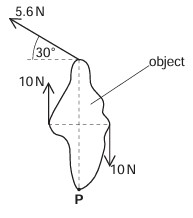
- A force, not shown on the diagram, also acts on the object at point P.
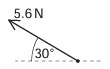
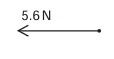
- Which of the following shows the correct direction and magnitude of the force acting at point P?
- A.
 B.
B. 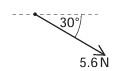 C.
C. 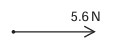
 D.
D. - Answer: B
- Explain:
- The two vertical 10 N forces point in opposite directions and completely balance each other out vertically. For the entire object to remain in translational equilibrium, the net force must be zero. Therefore, the unknown force acting at point P must exactly counteract the remaining 5.6 N force. Since the top force is 5.6 N pointing up and to the left at 30º to the horizontal, the balancing force at P must point in the exact opposite direction: down and to the right at 30º below the horizontal line, as shown in option B.
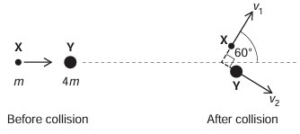
- 6. A particle X of mass m collides with a stationary particle Y of mass 4m.
- Immediately after the collision the particle X is moving at velocity v1 at an angle of 60° to its original direction and the particle Y is moving with velocity v2 at 90° to the velocity of particle X.
-
- What is the value of the ratio [math]\frac{V_1}{V_2}[/math]?
- A. 2.3
- B.3.9
- C. 4.0
- D. 6.9
- Answer: A
- Explain:
- – Let the original direction of particle X be along the horizontal axis.
- – Since particle Y moves at 90º 𝑟𝑒𝑙𝑎𝑡𝑖𝑣𝑒 𝑡𝑜 𝑝𝑎𝑟𝑡𝑖𝑐𝑙𝑒 𝑋 (𝑤ℎ𝑖𝑐ℎ 𝑖𝑠 𝑎𝑡 + 60º), particle Y must move at an angle of
- 60º − 90º = −30º
- relative to the horizontal axis.
- – Applying the conservation of linear momentum perpendicular to the initial direction of motion (vertically)
- [math]
\begin{aligned}
0 &= mv_1\sin 60^\circ – 4mv_2\sin 30^\circ \\
mv_1\sin 60^\circ &= 4mv_2\sin 30^\circ \\
v_1\left(\frac{\sqrt{3}}{2}\right) &= 4v_2\left(\frac{1}{2}\right) \\
v_1\sqrt{3} &= 4v_2 \\
\frac{v_1}{v_2} &= \frac{4}{\sqrt{3}}
\end{aligned}
[/math] - 7. A metal block of mass m is heated by an electric heater.
- The graph of temperature θ against time t for this block is shown below.
-
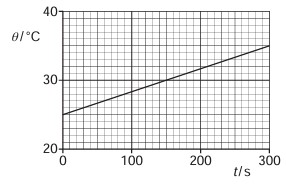
- The power of the heater is P. The gradient of the straight-line graph is G.
- What is the correct expression for the specific heat capacity c of the metal?
- A. 𝒄 = 𝑮
- B. [math]c = \frac{PG}{m}[/math]
- C. [math] c = \frac{mP}{G} [/math]
- D. [math] c = \frac{P}{mG}[/math]
- Answer: D
- Explain:
- – The thermal energy supplied by the heater in time t is given by
- 𝑄 = 𝑃. 𝑡
- – The heat energy absorbed by the metal block is
- 𝑄 = 𝑚𝑐∆𝜃
- – The gradient G of the temperature – time graph is
- [math]
\begin{aligned}
G = \frac{\Delta\theta}{t} \\
\text{Meaning: } \Delta\theta &= Gt \\
\text{Substituting this back into the equation:} \\
Pt &= mc(Gt) \\
P &= mcG \\
c &= \frac{P}{mG}
\end{aligned}
[/math]
- 8. Which statement(s) below are implied by the assumptions of the kinetic theory model of gases?
- 1 A gas is mostly empty space.
- 2 Gas particles spend more time between collisions than time during collisions.
- 3 There are always forces between the gas particles.
- A. Only 1 and 2
- B. Only 1 and 3
- C. Only 2 and 3
- D. 1, 2 and 3
- Answer: A
- Explain:
- – Statement 1 is correct: Kinetic theory assumes that the volume of the gas particles is negligible compared to the total volume of the container, making it mostly empty space.
- – Statement 2 is correct: The duration of a collision is assumed to be negligible compared to the time spent by particles traveling between collisions.
- – Statement 3 is incorrect: Ideal kinetic theory explicitly assumes there are no intermolecular forces between gas particles except during their instantaneous elastic collisions.
- 9. A container has 1.0 mole of gas at pressure [math]100\ \text{kPa}[/math].
- The root mean square (r.m.s.) speed of the gas particles is [math]500\ \text{m}\ \text{s}^{-1}[/math]. The mass of each gas particle is [math]4.7 \times 10^{-26}\ \text{kg}[/math]. What is the volume of the container?
- A. [math]3.9 \times 10^{-26}\ \text{m}^{3}[/math]
- B. [math]4.7 \times 10^{-5}\ \text{m}^{3}[/math]
- C. [math]2.4 \times 10^{-2}\ \text{m}^{3}[/math]
- D. [math]4.7 \times 10^{-2}\ \text{m}^{3}[/math]
- Answer: C
- Explain:
- Using the kinetic theory of gases, the pressure P is related to the volume V, the total number of molecules N, the mass of each molecule m, and the root-mean-square speed [math]v_{\text{rms}}[/math] by the equation:
- [math]P=\frac{1}{3}\frac{Nmv_{\text{rms}^{2}}}{V}[/math]
- Find the total number of particles (N):
- Since we have [math]1.0[/math] mole of gas,
- [math]N=n\times N_{A}[/math]
- [math]N=1.0\times6.02\times10^{23}[/math]
- [math]N=6.02\times10^{23}[/math]
- Rearrange for volume (V):
- [math]V=\frac{1}{3}\frac{Nmv_{\text{rms}^{2}}}{P}[/math]
- [math]V=\frac{1}{3}\frac{(6.02\times10^{23})(4.7\times10^{-26})(500)^{2}}{100\times10^{3}}[/math]
- [math]V= \frac{(2.8294\times10^{-2})(250000)}{300000}[/math]
- [math]V=0.0236\ \text{m}^{3}[/math]
- [math]V=2.4\times10^{-2}\ \text{m}^{3}[/math]
- 10. A mass is attached to the bottom end of a spring which is fixed at its top end.
- The mass is displaced vertically, and then released. The mass oscillates with a simple harmonic motion.
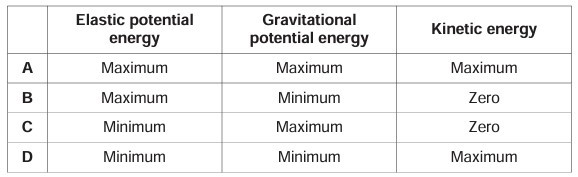
- Which row correctly describes the energy of this spring-mass system when the mass is at its lowest point in its oscillations?
- Answer: B
- Explain:
- Let’s analyze the vertical spring-mass system at its lowest point of oscillation:
- – Elastic potential energy: The spring experiences its maximum extension at the lowest point, meaning the elastic potential energy
- [math]E_{e}=\frac{1}{2}kx^{2}[/math]
- is at its maximum.
- Gravitational potential energy: This is the lowest vertical position in the path, which means height [math]h[/math] is at a minimum. Thus, gravitational potential energy
- [math]E_{g}=mgh[/math]
- Is at its maximum.
- Kinetic energy: At the extreme lowest point, the mass momentarily stops to reverse direction, meaning its velocity is zero. Thus, kinetic energy is Zero.
- 11. Which pair of quantities do not have the same, or equivalent, units?
- A. acceleration, gravitational field strength
- B. angular frequency, angular velocity
- C. gravitational potential, kinetic energy
- D. impulse, momentum
- Answer: C
- Explain:
- Gravitational potential has units of
- [math]\text{J}\ \text{kg}^{-1}[/math]
- while kinetic energy has units of [math]\text{J}[/math] (Joules). These are distinctly different quantities with nonequivalent units.
- 12. The diagram shows three energy levels X, Y and Z of an electron within a gas atom.
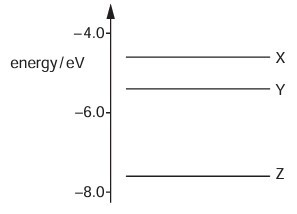
- Which transition is correct when the electron absorbs a photon with the shortest wavelength?
- A.

- B.

- C.

- D.

- Answer: A
- Explain:
- – Absorption vs. Emission: When an atom absorbs a photon, an electron moves from a lower (more negative) energy level to a higher (less negative) energy level. This rules out transitions B and D, which represent emission.
- – Shortest Wavelength: The energy of a photon is inversely proportional to its wavelength
- [math]E=\frac{hc}{\lambda}[/math]
- Therefore, the shortest wavelength corresponds to the largest energy change ([math]\Delta E[/math]).
- 13. Light from a hydrogen source is incident normally at a diffraction grating. The first order maximum of the H-alpha spectral line of wavelength 486 nm is observed at angle of 30.0°.
- Light from a distant receding star is observed using the same diffraction grating. The light is incident normally at the grating as before. The speed of this star is [math]0.16c[/math], where [math]c[/math] is the speed of light in a vacuum.
- What is the observed angle of the first order maximum of the H-alpha spectral line from the light of this receding star?
- A. 24.8°
- B. 30.0°
- C. 34.8°
- D. 35.5°
- Answer: D
- Explain:
- Find the grating spacing ([math]d[/math]):
- Using the grating equation
- [math]d\sin\theta=n\lambda[/math]
- for the local hydrogen source
- [math]n=1[/math]
- [math]d\sin30^{\circ}=1(486\ \text{nm})[/math]
- [math]d(0.5)=486\ \text{nm}[/math]
- [math]d=\frac{486\ \text{nm}}{0.5}[/math]
- [math]d=972\ \text{nm}[/math]
- Calculate the Doppler-shifted wavelength from the receding star:Because the star is receding (moving away), its light experiences a relativistic Doppler redshift:
- [math]\lambda’=\lambda\sqrt{\frac{1+\frac{v}{c}}{1-\frac{v}{c}}}[/math]
- [math]\lambda’=486\sqrt{\frac{1+0.16}{1-0.16}}[/math]
- [math]\lambda’ = 486\sqrt{\frac{1.16}{0.84}}[/math]
- [math]\lambda’=486(1.175)[/math]
- [math]\lambda’=571.1\ \text{nm}[/math]
- [math]\sin\theta’=\frac{n\lambda’}{d}[/math]
- [math]\sin\theta’=\frac{(1)(571.1)}{972}[/math]
- [math]\sin\theta’=0.5875[/math]
- [math]\theta’=\sin^{-1}(0.5875)[/math]
- [math]\theta’=35.98^{\circ}[/math]
- 14. A galaxy, [math]1.0\times10^{9}\ \text{light-years}[/math] away from the Earth, has a recession speed of [math]23000\ \text{km}\ \text{s}^{-1}[/math]. Which expression, based on the information above, is correct for the age of the universe in seconds?
- A. [math]\text{age}=\frac{1.0\times10^{9}}{23000\times10^{3}}[/math]
- B. [math]\text{age}=\frac{1.0\times10^{9}\times1.5\times10^{11}}{23000}[/math]
- C. [math]\text{age}=\frac{1.0\times10^{9}\times9.5\times10^{15}}{23000\times10^{3}}[/math]
- D. [math]\text{age}=\frac{1.0\times10^{9}\times3.1\times10^{16}}{23000\times10^{3}}[/math]
- Answer: C
- Explain:
- – By Hubble’s Law, the recession speed is
- [math]v=H_{0}d[/math]
- The approximate age of the universe is given by the Hubble time
- [math]t=\frac{1}{H_{0}}=\frac{d}{v}[/math]
- – Convert Distance ([math]d[/math]) to meters:
- – The distance is [math]1\times10^{9}[/math] Light – year. Since
- [math]1\ \text{light-year}=9.5\times10^{15}\ \text{meters}[/math]
- the distance in meters is:
- [math]\text{Numerator}=1.0\times10^{9}\times9.5\times10^{15}[/math]
- Convert Speed ([math]v[/math]) to meters per second:
- The recession speed is [math]23000\ \text{km}\ \text{s}^{-1}[/math].
- [math]\text{Denominator}=23000\times10^{3}[/math]
- 15. Astronomers observe approximately the same number of distant galaxies per unit volume of space in all directions. Which idea does this observation support?
- A. Big bang model of the universe
- B. Cosmological principle
- C. Existence of dark matter
- D. Hubble’s law
- Answer: B
- Explain:
- – The Cosmological Principle states that on a large enough scale, the universe is both homogeneous (the same structural makeup everywhere) and isotropic (looks the same in all directions).Observing roughly the same number of distant galaxies per unit volume of space in all directions directly supports the claim that the universe is isotropic, which is a core tenet of the Cosmological Principle.
-
SECTION B
-
Answer all the questions.
- 16.
- (a) Describe how an experiment can be carried out to determine the force constant of an elastic cord in the laboratory by plotting a suitable graph. You may assume that the cord obeys Hooke’s law.
- Explain:
- Determining the Force Constant of an Elastic Cord
- Experimental Setup \& Procedure:
- 1. Suspend the elastic cord vertically from a secure rigid support (such as a clamp attached to a retort stand).
- 2. Attach a mass hanger to the free lower end of the cord. Place a meter rule vertically parallel to the cord to measure its position.
- 3. Measure the initial position of the lower end of the cord without any slotted masses attached to determine its unstretched length ([math]l_0[/math]).
- 4. Add a known mass ([math]m[/math]) to the hanger, record the new position of the lower end, and calculate the extension:
- [math]x=l-l_0[/math]
- 5. Repeat this process by adding further known masses in regular increments (e.g., 100 g, 200 g, etc.), measuring the total extension [math]x[/math] for each load force ([math]F=mg[/math]). Ensure the cord does not exceed its elastic limit.
- Graph and Analysis:
- – Plot a graph of Force ([math]F[/math]) on the y-axis against Extension ([math]x[/math]) on the x-axis.
- – According to Hooke’s Law ([math]F=kx[/math]), the plot will yield a straight line passing through the origin.
- – Calculate the gradient (slope) of this linear region. The force constant ([math]k[/math]) is directly equal to the gradient:
- [math]\text{Gradient}=\frac{\Delta F}{\Delta x}=k[/math]
- (b) A simple catapult is made by an elastic cord fixed to two supports, as shown below.
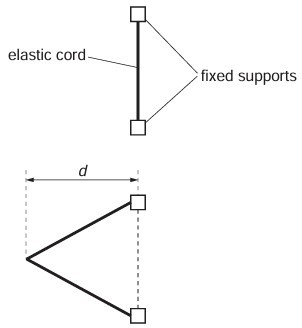
- The unstretched length of the cord is the same as the distance between the supports. The distance that the centre of the cord has been pulled back is [math]d[/math].
- The cord has a force constant of [math]500\ \mathrm{N\,m^{-1}}[/math].
- The variation of the extension of the cord with distance [math]d[/math] is shown below.
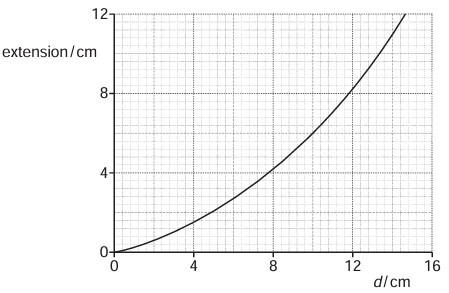
- A small ball of mass 30 g is placed at the centre of the cord and drawn back with [math]d=10\ \mathrm{cm}[/math].
- The ball is released and launched horizontally from a height of [math]1.5\ \mathrm{m}[/math] above the horizontal ground.
- (i) Use the graph to show that the elastic potential energy [math]E[/math] in the cord is about [math]1\ \mathrm{J}[/math].
- Explain:
- 1. Find the Extension from the Graph:
- From the extension vs. [math]d[/math] graph, locate [math]d=10\ \mathrm{cm}[/math] on the horizontal axis. Follow it up to the curve to find the corresponding extension on the vertical axis.
- [math]x=6.0\ \mathrm{cm}=0.060\ \mathrm{m}[/math]
- 2. Calculate Elastic Potential Energy ([math]E[/math]):
- Since the cord obeys Hooke’s Law with a force constant [math]k=500\ \mathrm{N\,m^{-1}}[/math]:
- [math]E=\frac{1}{2}kx^2[/math]
- [math]E=\frac{1}{2}(500)(0.060)^2[/math]
- [math]E=(250)(0.0036)[/math]
- [math]E=0.90\ \mathrm{J}[/math]
- (ii) Show that the maximum speed at which the ball leaves the catapult is about [math]8\ \mathrm{m\,s^{-1}}[/math].
- Explain:
- Show that the Maximum Speed is about [math]8\ \mathrm{m\,s^{-1}}[/math]:
- Assuming total conservation of energy, the elastic potential energy ([math]E[/math]) stored in the cord is converted completely into the kinetic energy (KE) of the ball as it leaves the catapult:
- [math]\frac{1}{2}mv^2=E[/math]
- Given mass [math]m=30\ \mathrm{g}=0.030\ \mathrm{kg}[/math] and using our calculated value [math]E=0.90\ \mathrm{J}[/math]:
- [math]\frac{1}{2}mv^2=\frac{1}{2}(0.030)v^2=0.90[/math]
- [math]v^2=\frac{2(0.90)}{0.030}[/math]
- [math]v=\sqrt{\frac{2(0.90)}{0.030}}[/math]
- [math]v=\sqrt{60}[/math]
- [math]v=7.7\ \mathrm{m.s^{-1}}[/math]
- (iii) Calculate the horizontal distance R travelled by the ball before it strikes the horizontal ground.
- Ignore the effects of air resistance in your calculation.
- Explain:
- Calculate the horizontal distance R:
- The ball is launched horizontally from a height [math]h=1.5\ \mathrm{m}[/math] with an initial horizontal velocity
- [math]u_x=7.7\ \mathrm{m\,s^{-1}}[/math] and initial vertical velocity [math]u_y=0[/math].
- 1. Find Time of Flight ([math]t[/math]):
- Using the vertical motion formula ([math]h=\frac{1}{2}gt^2[/math],where [math]g=9.81\ \mathrm{m.s^{-2}}[/math]):
- [math]1.5=\frac{1}{2}gt^2=\frac{1}{2}(9.81)t^2[/math]
- [math]t^2=\frac{2(1.5)}{9.81}[/math]
- [math]t=\sqrt{\frac{2(1.5)}{9.81}}[/math]
- [math]t=\sqrt{0.3058}[/math]
- [math]t=0.553\ \mathrm{s}[/math]
- 2. Calculate Horizontal Range ([math]R[/math]):
- [math]R=u_xt[/math]
- [math]R=(7.7)(0.553)[/math]
- [math]R=4.29\ \mathrm{m}[/math]
- (iv) Explain how the value of R calculated in (iii) compares with the actual value.
- Explain:
- The actual value of [math]R[/math] will be less than the calculated value of [math]4.29\ \mathrm{m}[/math].
- Explanation:
- In reality, air resistance acts against the motion of the ball, reducing its horizontal velocity components during flight.Additionally, some energy is lost as thermal energy or sound when the cord snaps back, meaning the launch velocity is slightly lower than calculated.
- 17. An electric engine of mass 17 000 kg has a constant power output of 280 kW and it can reach a maximum speed of [math]42\,\mathrm{m\,s^{-1}}[/math]on horizontal rails. The maximum kinetic energy of the engine is 15 MJ.
- (a) The engine is initially at rest on long horizontal rails.
- Show that the minimum time taken for the engine to reach its maximum speed is about 1 minute.
- Explain:
- Show that the Minimum Time taken is about 1 minute:
- – By the Work-Energy Theorem, the work done by the engine goes into increasing its kinetic energy. The maximum kinetic energy reached is given as [math]E_k=15\ \mathrm{MJ}=15\times10^6\ \mathrm{J}[/math].
- – Since Power ([math]P[/math]) is the rate of doing work ([math]P=\frac{\Delta E}{t}[/math]), the minimum time occurs when the engine operates at its maximum constant power output [math]P=280\ \mathrm{kW}=280\times10^3\ \mathrm{W}[/math]:
- [math]P=\frac{\Delta E}{t}[/math]
- [math]t=\frac{15\times10^6}{280\times10^3}[/math]
- [math]t=54\ \mathrm{s}[/math]
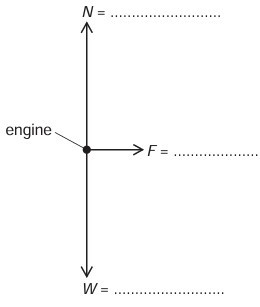
- (b) The engine is moving along the horizontal rails at the constant maximum speed of [math]42\,\mathrm{m\,s^{-1}}[/math]. The weight of the engine is [math]W[/math], the total normal contact force from the rails is [math]N[/math] and the total friction between the wheels and the rails is [math]F[/math].
- [math]F[/math] is responsible for the motion of the engine to the right.
- Complete the free body diagram for the engine by showing a missing force, and the magnitudes of all the forces. There is space for you to do any calculations below the diagram.
- Explain:
- Free Body Diagram for the Engine:
- When the engine travels at its constant maximum speed ([math]v=42\ \mathrm{m\,s^{-1}}[/math]), it is in dynamic equilibrium, meaning the net horizontal and vertical forces must balance to zero.
- 1. Calculate Weight ([math]W[/math]):
- [math]W=mg[/math]
- [math]W=(17\,000)(9.81)[/math]
- [math]W=166,770\ \mathrm{N}[/math]
- [math]W=1.67\times10^5\ \mathrm{N}[/math]
- 2. Calculate Normal Contact Force ([math]N[/math]):
- [math]N=W=1.67\times10^5\ \mathrm{N}[/math]
- 3. Calculate Driving Force ([math]F[/math]):
- Using the relationship between power, force, and maximum velocity:
- [math]P=Fv[/math]
- [math]280\times10^3=F(42)[/math]
- [math]F=\frac{280\times10^3}{42}[/math]
- [math]F=6,667\ \mathrm{N}[/math]
- 4. Identify the Missing Force:
- Because the engine moves at a constant speed, the net horizontal force must be zero.
- Therefore, there must be a resistive force (friction/air resistance) acting to the left to perfectly balance F.
- (c) The speed of the engine is 42 m s⁻¹.
- The driver sees an obstruction 167 m from the front of the engine.
- The engine is switched off and the brakes are applied.
- The constant force opposing motion is 120 kN.
- The reaction time of the driver is 0.40 s.
- Show with the help of calculations, that the engine will stop before reaching the obstruction.
- Explain:
- 1. Reaction Distance ([math]d_{\text{reaction}}[/math]):
- During the driver’s reaction time (t = 0.40 s), the train continues to move at a constant speed of 42 m s⁻¹:
- [math]d_{\text{reaction}}=vt=42\times0.40=16.8\,\text{m}[/math]
- 2. Braking Distance ([math]d_{\text{braking}}[/math]):
- When brakes are applied, the constant opposing force is
- [math]F_{\text{opposing}}=120\,\text{kN}=120000\,\text{N}[/math]
- Calculate deceleration (a) using Newton’s second law (F = ma):
- [math]a=\frac{F_{\text{opposing}}}{m}[/math]
- [math]a=\frac{120000}{17000}[/math]
- [math]a=7.06\,\text{m s}^{-2}[/math]
- Using the equation of motion
- [math]v^2=u^2-2ad_{\text{braking}}[/math]
- Where [math]v=0[/math]
- [math]0=(42)^2-2(7.06)d_{\text{braking}}[/math]
- [math]d_{\text{braking}}=\frac{(42)^2}{2(7.06)}[/math]
- [math]d_{\text{braking}}=124.9\,\text{m}\approx125\,\text{m}[/math]
- 3. Total Stopping Distance ([math]d_{\text{total}}[/math])
- [math]d_{\text{total}}=d_{\text{reaction}}+d_{\text{braking}}[/math]
- [math]=16.8\,\text{m}+124.9\,\text{m}[/math]
- [math]d_{\text{total}}=141.7\,\text{m}\approx142\,\text{m}[/math]
- Conclusion:
- Since the total stopping distance 142 m is less than the distance to the obstruction (167 m), the engine will successfully stop safely before hitting it.
- [math]167-142=25\,\text{m}[/math]
- clear.
- 18. A tent is secured by 3 ropes along each of its long sides, as shown in Fig. 18.1.
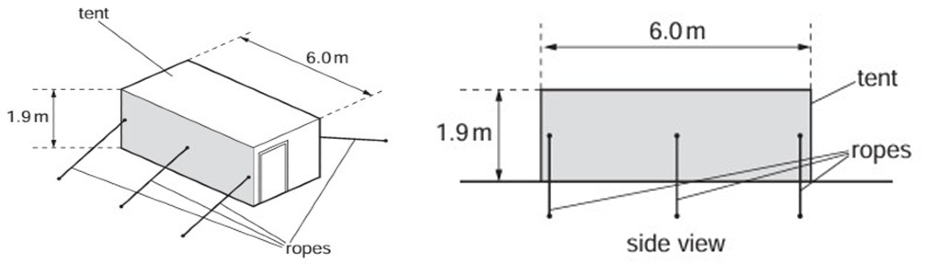
- (a) Wind of speed 12 m s⁻¹ blows at right angles to the shaded side of the tent for 3.0 s.The density of air is 1.2 kg m⁻³.
- (i) Show that the mass of air which hits the tent in this time is about 490 kg.
- Explain:
- Show that the Mass of Air hitting the tent is about 490 kg.
- 1. Calculate the Area (A) of the shaded side:
- [math]A=\text{length}\times\text{height}[/math]
- [math]A=6.0\,\text{m}\times1.9\,\text{m}[/math]
- [math]A=11.4\,\text{m}^2[/math]
- 2. Calculate the Volume (V) of air moving past in [math]t=3.0\,\text{s}[/math] at speed [math]v=12\,\text{m s}^{-1}[/math]
- [math]V=A\times(v \times t)= 11.4\,\text{m}^2\times(12\,\text{m s}^{-1}\times3.0\,\text{s})[/math]
- [math]V=11.4 \times 36 =410.4\,\text{m}^3[/math]
- 3. Calculate Mass (m) using density [math]\rho=1.2\,\text{kg m}^{-3}[/math]
- [math]m=\rho \times V =1.2\times410.4=492.48\,\text{kg}[/math]
- Conclusion: This value cleanly rounds to approximately [math]490\,\text{kg}[/math]
- (ii) All of the air incident on the shaded side of the tent is deflected at 90° to the original direction as shown in Fig. 18.2.
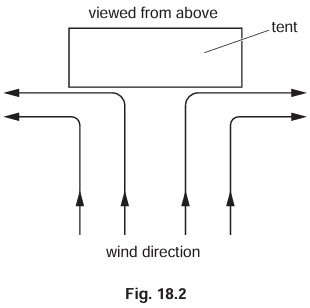
- Use the information given in (a)(i) to calculate the magnitude of the force F exerted by the wind on the shaded side of the tent.
- Explain:
- Calculate the Magnitude of the Force (F) exerted by the Wind.
- Force is defined by Newton’s second law as the rate of change of momentum ([math]\frac{\Delta p}{\Delta t}[/math])
- The air approaches the tent at an initial velocity of [math]12\,\text{m s}^{-1}[/math] perpendicular to the surface.As shown in Fig. 18.2, it is deflected at
- [math]90^\circ[/math] meaning its final velocity component perpendicular to the tent face becomes [math]0\,\text{m s}^{-1}[/math]
- Calculate Change in Perpendicular Velocity:
- [math]\Delta v=12\,\text{m s}^{-1}-0\,\text{m s}^{-1}=12\,\text{m s}^{-1}[/math]
- Calculate Force (F):
- [math]F=\frac{\Delta p}{\Delta t}[/math]
- [math]F=\frac{m\Delta v}{\Delta t}[/math]
- [math]F=\frac{(492.48)(12)}{3.0}[/math]
- [math]F=492.48\times4[/math]
- [math]F=1970\,\text{N}[/math]