
OCR A Physics OCR Paper 1 2019
-
SECTION A
-
You should spend a maximum of [math]30\ \text{minutes}[/math] on this section.
-
Write your answer to each question in the box provided.
-
Answer all the questions
- 1. Which set of prefixes A, B, C or D are in order of increasing magnitude?
- A. micro, milli, centi, kilo
- B. milli, centi, micro, kilo
- C. kilo, centi, milli, micro
D. centi, micro, milli, kilo - Answer: A
- Reason:
- SI prefixes values are:
- [math]\text{micro}\ (\mu)=10^{-6}=0.000001[/math]
- [math]\text{milli}\ (m)=10^{-3}=0.001[/math]
- [math]\text{centi}\ (c)=10^{-2}=0.01[/math]
- [math]\text{kilo}\ (k)=10^{3}=1000[/math]
- Increasing magnitude means smallest → largest:
- [math]\text{micro}<\text{milli}<\text{centi}<\text{kilo}[/math]
- So correct order is:
- [math]10^{-6}<10^{-3}<10^{-2}<10^{3}[/math]
- Therefore, Option A is correct.
- 2. A paper cone is held above the ground and dropped. It falls vertically and reaches terminal velocity before it hits the ground.
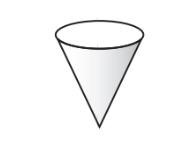
- Which statement correctly describes the resultant force on the falling cone before it reaches terminal velocity?
- A. decreasing and upwards
- B. decreasing and downwards
- C. increasing and downwards
- D. increasing and upwards
- Answer: B
- Reason:
- Forces on cone:
- – Weight acts downward (constant).
- – Air resistance acts upward.
- As speed increases:
- – Air resistance increases.
- – Resultant force decreases.
- Before terminal velocity:
- [math]\text{Weight}>\text{Air Resistance}[/math]
- So resultant force is:
- – downward
- – decreasing
- 3. A solid cylindrical glass rod has length [math]20.0\pm0.1\ \text{cm}[/math] and diameter [math]5.00\pm0.01\ \text{mm}[/math].
- What is the percentage uncertainty in the calculated volume of this rod?
- A. [math]0.1\text{%}[/math]
- B. [math]0.2\text{%}[/math]
- C. [math]0.7\text{%}[/math]
- D. [math]0.9\text{%}[/math]
- Answer: D
- Reason:
- Length [math]=l=20.0\pm0.1\ \text{cm}[/math]
- Diameter [math]=d=5.00\pm0.01\ \text{mm}[/math]
- Volume of cylinder:
- [math]V=\pi r^{2}l[/math]
- Percentage uncertainty in length:
- [math]\frac{0.1}{20.0}\times100[/math]
- [math]=0.5\text{%}[/math]
- Percentage uncertainty in diameter:
- [math]\frac{0.01}{5.00}\times100[/math]
- [math]=0.2\text{%}[/math]
- Since diameter is squared:
- [math]2(0.2\text{%})=0.4\text{%}[/math]
- Add uncertainties:
- [math]0.5\text{%}+0.4\text{%}=0.9\text{%}[/math]
- 4. A simple harmonic oscillator has maximum speed [math]24\ \text{m}\ \text{s}^{-1}[/math] and amplitude [math]5.6\ \text{cm}[/math].
- What is its angular frequency?
- A. [math]0.23\ \text{rad}\ \text{s}^{-1}[/math]
- B. [math]21\ \text{rad}\ \text{s}^{-1}[/math]
- C. [math]68\ \text{rad}\ \text{s}^{-1}[/math]
- D. [math]430\ \text{rad}\ \text{s}^{-1}[/math]
- Answer: D
- Reason:
- A simple harmonic oscillator has:
- Maximum speed [math]= 24\ \text{m}\ \text{s}^{-1}[/math]
- Amplitude [math]= 5.6\ \text{cm} = 0.056\ \text{m}[/math]
- Find angular frequency.
- For SHM:
- [math]v_{\text{max}} = \omega A[/math]
- So:
- [math]\omega = \frac{v_{\text{max}}}{A}[/math]
- Substitute values:
- [math]\omega = \frac{24}{0.056}[/math]
- [math]\omega = 428.57 \approx 430\ \text{rad}\ \text{s}^{-1}[/math]
- 5. A car is dripping oil at a steady rate on a straight road. The road is divided into four sections A, B, C, and D.
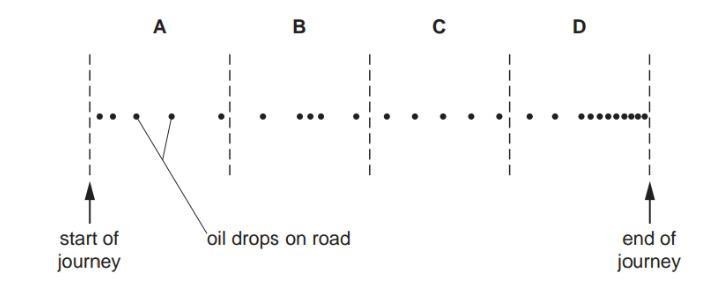
- Which section of the road shows the car travelling at a constant speed?
- Answer: C
- Reason:
- Since oil drops fall at equal time intervals, the distance between drops shows how far the car travels in equal times.
- – Large spacing = high speed
- – Small spacing = low speed
- – Equal spacing = constant speed
- In section C, the oil drops are equally spaced.
- This means:
- – In every equal time interval, the car covers the same distance.
- – So, speed is constant.
- Hence, constant speed = Section C.
- 6. The Earth is surrounded by a gravitational field.
- Which of the following statements is/are correct about the gravitational field lines near the surface of the Earth.
- 1. They are parallel.
- 2. They show the direction of the force on a small mass.
- 3. They are equally spaced.
- A. Only 1
- B. Only 1 and 2
- C. Only 2 and 3
- D. 1, 2 and 3
- Answer: D
- Reason:
- “They are parallel.”
- True
- Near Earth’s surface field lines are nearly parallel.
- “They show direction of force on a small mass.”
- True
- Field lines indicate force direction.
- “They are equally spaced.”
- True
- Uniform field → equal spacing.
- D (1, 2 and 3)
- 7. A pendulum bob is oscillating in a vacuum.
- The maximum height of the bob from the ground is [math]1.3\ \text{m}[/math] and its minimum height is [math]1.1\ \text{m}[/math].
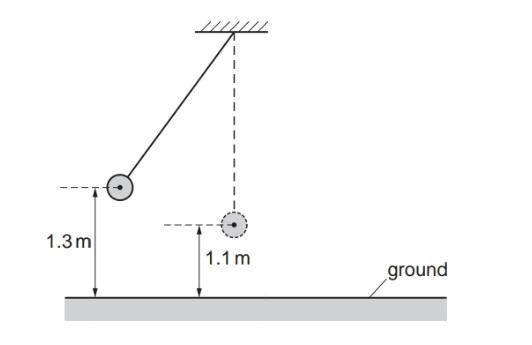
- What is the maximum speed of the pendulum bob?
- A. [math]2.0\ \text{m}\ \text{s}^{-1}[/math]
- B. [math]3.9\ \text{m}\ \text{s}^{-1}[/math]
- C. [math]5.1\ \text{m}\ \text{s}^{-1}[/math]
- D. [math]26\ \text{m}\ \text{s}^{-1}[/math]
- Answer: A
- Reason:
- Highest Point: [math]h_{1} = 1.3\ \text{m}[/math]
- Lowest Point: [math]h_{2} = 1.1\ \text{m}[/math]
- Height Fallen: [math]\Delta h = 0.2\ \text{m}[/math]
- Use Conservation of energy:
- Loss in GPE:
- [math]GPE = mg\Delta h[/math]
- Gain in KE:
- [math]KE = \frac{1}{2}mv^{2}[/math]
- [math]mg\Delta h = \frac{1}{2}mv^{2}[/math]
- [math]2g\Delta h = v^{2}[/math]
- [math]v = \sqrt{2g\Delta h}[/math]
- [math]v = \sqrt{2(9.8)(0.2)}[/math]
- [math]v = 1.98\ \text{m}.\ \text{s}^{-1}[/math]
- 8. An object is falling.
- The weight of the object is [math]4.5\ \text{N}[/math].
- The wind provides a horizontal force of magnitude [math]F[/math] on the object.
- The resultant force on the object is [math]5.8\ \text{N}[/math].
- Air resistance and upthrust on the object are negligible.
- What is the value of [math]F[/math]?
- A. [math]1.3\ \text{N}[/math]
- B. [math]3.7\ \text{N}[/math]
- C. [math]7.3\ \text{N}[/math]
- D. [math]13\ \text{N}[/math]
- Answer: B
- Reason:
- Weight: [math]W = 4.5\ \text{N}[/math]
- Horizontal force: [math]F = ?[/math]
- Resultant: [math]R = 5.3\ \text{N}[/math]
- According to Pythagoras theorem:
- [math]R^{2} = W^{2} + F^{2}[/math]
- [math](5.8)^{2} = (4.5)^{2} + F^{2}[/math]
- [math]F^{2} = 33.64 – 20.25[/math]
- [math]F^{2} = 13.39[/math]
- [math]F = 3.66\ \text{N}[/math]
- [math]F = 3.7\ \text{N}[/math]
- 9. A solid molecular substance is supplied with energy and it starts to melt.
- Which of the following pairs of quantities remains the same as the substance melts?
- A. Kinetic energy of molecules and internal energy of molecules.
- B. Potential energy of molecules and internal energy of molecules.
- C. Kinetic energy of molecules and temperature of substance.
- D. Potential energy of molecules and temperature of substance.
- Answer: C
- Reason:
- During melting:
- – Temperature remains constant.
- – Average kinetic energy remains constant.
- Energy supplied increases intermolecular separation.
- Therefore:
- – Potential energy increases.
- – Internal energy increases.
- 10. Which of the following shows the correct base units for pressure?
- A. [math]\text{kg}\ \text{m}^{-2}[/math]
- B. [math]\text{kg}\ \text{m}^{-2}\text{s}^{-2}[/math]
- C. [math]\text{kg}\ \text{m}^{-1}\text{s}^{-2}[/math]
- D. [math]\text{kg}\ \text{m}^{2}\text{s}^{-3}[/math]
- Answer: C
- Reason:
- Pressure:
- [math]P=\frac{F}{A}[/math]
- Force:
- [math]F=ma[/math]
- [math]F=(\text{kg})(\text{m}.\ \text{s}^{-2})[/math]
- [math]F=\text{kg}\text{m}.\ \text{s}^{-2}[/math]
- Therefore:
- [math]P=\frac{F}{A}[/math]
- [math]P=\frac{\text{kg}\text{m}.\ \text{s}^{-2}}{\text{m}^{2}}[/math]
- [math]P=\text{kg}\text{m}^{-1}.\ \text{s}^{-2}[/math]
- 11. A student has collected some data on the Solar System.
- The student plots a graph, but only two data points are shown below.
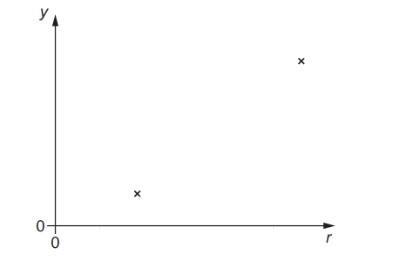
- The distance from the centre of the Sun is [math]r[/math].
- Which quantity [math]y[/math] is represented on the vertical axis?
- A. Speed of a planet.
- B. Period of a planet.
- C. Gravitational potential of the Sun.
- D. Gravitational field strength of the Sun.
- Answer: B
- Reason:
- The graph shows:
- – [math]y[/math] increases as [math]r[/math] increases.
- Check each quantity:
- A Speed:
- [math]v\propto\frac{1}{\sqrt{r}}[/math]
- Decreases with [math]r[/math].
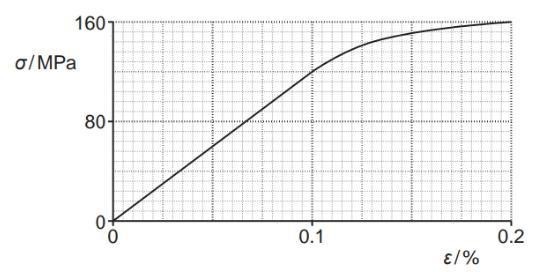
- 12. A graph showing the variation of the stress [math]\sigma[/math] with strain [math]\varepsilon[/math] for a material is shown below.
- What is the Young modulus of the material?
- A. [math]6.0\times10^{4}\ \text{Pa}[/math]
- B. [math]1.2\times10^{9}\ \text{Pa}[/math]
- C. [math]8.0\times10^{10}\ \text{Pa}[/math]
- D. [math]1.2\times10^{11}\ \text{Pa}[/math]
- Answer: D
- Reason:
- Young modulus is:
- [math]E=\frac{\text{stress}}{\text{strain}}[/math]
- Use the straight-line (elastic) region of the graph.
- From the graph:
- At
- [math]\varepsilon=0.10\text{%}[/math]
- And
- [math]\sigma=120\ \text{MPa}[/math]
- Convert units:
- [math]120\ \text{MPa}=120\times10^{6}\ \text{Pa}[/math]
- [math]0.10\text{%}=\frac{0.10}{100}=0.001[/math]
- Calculation:
- [math]E=\frac{\text{stress}}{\text{strain}}[/math]
- [math]E=\frac{120\times10^{6}}{0.001}[/math]
- [math]E=1.2\times10^{11}\ \text{Pa}[/math]
- 13. Which column A, B, C or D, shows the correct sequence for the evolution of the Universe between the Big Bang and the formation of stars?
-
A B C D Universe starts to expand ↓
quarks and leptons
form
↓
hadrons form
↓
nuclei form
↓
atoms form
Universe starts to expand ↓
hadrons form
↓
quarks and leptons form
↓
nuclei form
↓
atoms form
quarks and leptons form
↓
nuclei form
↓
Universe starts to expand
↓
atoms form
↓
hadrons form
quarks and leptons form
↓
hadrons form
↓
Universe starts to expand
↓
nuclei form
↓
atoms form
- Answer: A
- Reason:
- After the Big Bang:
- 1. Universe starts to expand
- 2. Quarks and leptons form
- 3. Hadrons form (protons and neutrons)
- 4. Nuclei form
- 5. Atoms form
- 6. Stars form later
- Only A follows the correct order:
- [math]\text{Expansion}\rightarrow\text{Quarks and leptons}\rightarrow\text{Hadrons}\rightarrow\text{Nuclei}\rightarrow\text{Atoms}[/math]
- Immediately after the Big Bang the Universe expanded rapidly.
- As it cooled:
- – Quarks and leptons were produced.
- – Quarks combined to form hadrons.
- – Protons and neutrons combined to form nuclei.
- – Electrons joined nuclei to form atoms.
- – Gas clouds later collapsed to form stars.
- 14. Some stars will evolve into white dwarfs.
- The mass of the Sun is [math]2.0\times10^{30}\ \text{kg}[/math].
- Which of the following cannot be the mass of a white dwarf?
- A. [math]1.2\times10^{30}\ \text{kg}[/math]
- B. [math]2.0\times10^{30}\ \text{kg}[/math]
- C. [math]2.7\times10^{30}\ \text{kg}[/math]
- D. [math]3.2\times10^{30}\ \text{kg}[/math]
- Answer: D
- Reason:
- Mass of Sun:
- [math]M_{\odot}=2.0\times10^{30}\ \text{kg}[/math]
- Important Physics:
- A white dwarf cannot exceed the Chandrasekhar Limit:
- [math]1.4M_{\odot}=1.4(2.0\times10^{30})=2.8\times10^{30}\ \text{kg}[/math]
- White dwarfs are supported by electron degeneracy pressure.
- If the mass exceeds approximately
- [math]1.4M_{\odot}[/math]
- The white dwarf becomes unstable and may collapse into a neutron star.
- Since
- [math]3.2\times10^{30}\ \text{kg}[/math]
- Is greater than the Chandrasekhar limit, it cannot be the mass of a white dwarf.
- 15. An astronomer analyses the light from a distant galaxy.
- One of the spectral lines in the spectrum observed from the galaxy has wavelength [math]610\ \text{nm}[/math].
- The same spectral line has a wavelength of [math]590\ \text{nm}[/math] when measured in the laboratory.
- What is the speed of this galaxy?
- A. [math]9.8\times10^{6}\ \text{m}\ \text{s}^{-1}[/math]
- B. [math]1.0\times10^{7}\ \text{m}\ \text{s}^{-1}[/math]
- C. [math]2.9\times10^{8}\ \text{m}\ \text{s}^{-1}[/math]
- D. [math]3.0\times10^{8}\ \text{m}\ \text{s}^{-1}[/math]
- Answer: B
- Reason:
- Speed of the Galaxy:
- Given:
- Observed wavelength:
- [math]\lambda_{0}=610\ \text{nm}[/math]
- Laboratory wavelength:
- [math]\lambda=590\ \text{nm}[/math]
- Speed of light:
- [math]c=3.0\times10^{8}\ \text{m}.\ \text{s}^{-1}[/math]
- Calculate Redshift:
- [math]z=\frac{\Delta\lambda}{\lambda}[/math]
- [math]z=\frac{610-590}{590}[/math]
- [math]z=\frac{20}{590}[/math]
- [math]z=0.0339[/math]
- Use Doppler Approximation:
- For small redshifts:
- [math]z=\frac{v}{c}[/math]
- Therefore:
- [math]v=zc[/math]
- [math]v=(0.0339)(3.0\times10^{8})[/math]
- [math]v=1.02\times10^{7}\ \text{m}.\ \text{s}^{-1}[/math]
- [math]v=1.0\times10^{7}\ \text{m}.\ \text{s}^{-1}[/math]
- Q No.16
- (a) Explain what is meant by the ultimate tensile strength of a material.
- Answer:
- Ultimate Tensile Strength
- Ultimate tensile strength (UTS) is the maximum tensile stress that a material can withstand when it is stretched before it begins to fail (neck) or fracture.
- When a material is subjected to a tensile force:
- 1. It first deforms elastically.
- 2. It may then deform plastically.
- 3. The stress continues to increase until it reaches a maximum value.
- 4. This maximum value of stress is called the ultimate tensile strength.
- 5. After this point, the material starts to neck and eventually breaks.
- [math]\text{Ultimate tensile strength}=\frac{\text{Maximum Tensile Force}}{\text{Original cross sectional Area}}[/math]
- (b) A footbridge is supported by a number of metal cables of the same length.
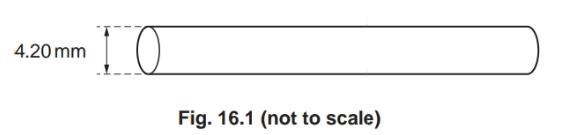
- Each cable has uniform cross-section and diameter [math]4.20\ \text{mm}[/math] as shown in Fig. 16.1.
- A group of engineers investigate how the extension [math]x[/math] varies with applied force [math]F[/math] for one of the cables.
- The results of the investigation are shown in Fig. 16.2.
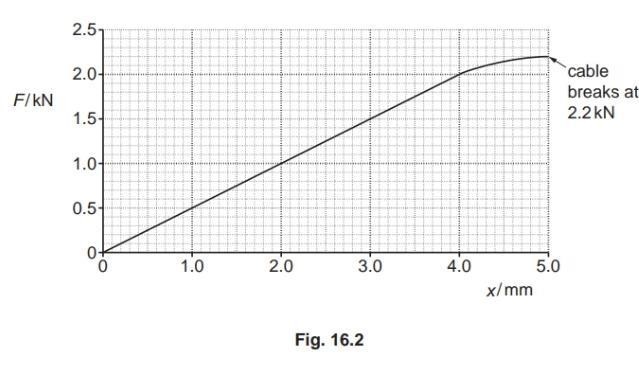
- The cable breaks when the force is [math]2.2\ \text{kN}[/math].
- (i) Describe how a suitable measuring device may have been used by the engineers to demonstrate that the cable had uniform cross-section.
- Answer:
- Use a micrometer screw gauge to measure the diameter of the cable at several positions along its length and in different directions.
- A cable has a uniform cross-section if its diameter is the same throughout.
- The engineers could:
- 1. Measure the diameter at many points along the cable using a micrometer.
- 2. Rotate the micrometer through [math]90^\circ[/math] at each position to check for circularity.
- 3. Compare all measurements.
- If all measured diameters are the same (within experimental uncertainty), the cable has a uniform cross-section.
- (ii) State any value of [math]F[/math] when the cable behaves
- 1. Elastically
- 2. Plastically.
- Answer:
- Elastically:
- The graph is a straight line from [math]0[/math] to approximately [math]4\ \text{mm}[/math] extension and [math]2.0\ \text{kN}[/math] force.
- In this region:
- – Force is proportional to extension.
- – Hooke’s Law is obeyed.
- – The cable returns to its original length when the force is removed.
- This is the elastic region.
- Therefore, a force such as:
- [math]1.5\ \text{kN}[/math]
- is acceptable.
- Plastically:
- After about [math]2.0\ \text{kN}[/math], the graph begins to curve.
- This means:
- – Force is no longer proportional to extension.
- – Hooke’s Law is no longer obeyed.
- – Permanent deformation occurs.
- This is the plastic region.
- Hence:
- [math]2.1\ \text{kN}[/math]
- is a suitable answer.
- (iii) Use Fig. 16.2 to determine the force constant [math]k[/math] in [math]\text{N}.\ \text{m}^{-1}[/math] of the cable.
- Answer:
- Given from graph:
- Choose a point in the straight-line region:
- [math]F=2.0\ \text{kN}[/math]
- [math]x=4.0\ \text{mm}[/math]
- Convert units:
- [math]F=2000\ \text{N}[/math]
- [math]x=4.0\times10^{-3}\ \text{m}[/math]
- Formula:
- [math]F=kx[/math]
- [math]k=\frac{F}{x}[/math]
- [math]k=\frac{2000}{4.0\times10^{-3}}[/math]
- [math]k=5.0\times10^{5}\ \text{N}.\ \text{m}^{-1}[/math]
- The force constant is the gradient of the straight-line section of the force-extension graph.
- [math]k=\frac{\Delta F}{\Delta x}[/math]
- Using any point from the elastic region gives:
- [math]5.0\times10^{5}\ \text{N}.\ \text{m}^{-1}[/math]