
OCR A Physics OCR Paper 1 2018
-
SECTION A
-
You should spend a maximum of 30 minutes on this section.
-
Write your answer to each question in the box provided.
-
Answer all the questions.
- 1. Which of the following units is not an S.I. base unit?
- A. ampere
- B. mole
- C. volt
- D. kilogram
- Answer: C
- Explain:
- – The SI system has 7 base units: meter (m), kilogram (kg), second (s), ampere (A), kelvin (K), mole (mol), and candela (cd).
- – Volt (V) is a derived unit for electric potential difference (equal to [math]\mathrm{kg}. \mathrm{m}^{2}. \mathrm{s}^{-3}. \mathrm{A}^{-1}[/math]).
- 2. Which set of quantities are all scalar?
- A. acceleration, displacement, velocity
- B. energy, mass, power
- C. extension, force, gravitational potential energy
- D. weight, kinetic energy, work done
- Answer: B
- Explain:
- – Scalar quantities have magnitude only, while vector quantities have both magnitude and direction.
- – Energy, mass, and power do not possess direction, meaning they are pure scalars. In the other options, acceleration, displacement, velocity, force, and weight are all vectors.
- 3. A metal block of mass 0.28 kg has an initial temperature of 82 °C. It is dropped into cold water. The temperature of the block after 1.2 minutes is 20 °C. The specific heat capacity of the metal is [math]130\ \mathrm{J}\ \mathrm{kg}^{-1}\ \mathrm{K}^{-1}[/math].
- What is the average thermal power transferred away from the metal block?
- A. 31 W
- B. 41 W
- C. 1900 W
- D. 2700 W
- Answer: A
- Explain:
- – Calculate the thermal energy (Q):
- [math]Q = mc\Delta\theta[/math]
- [math]Q = (0.28)(130)(82 – 20)[/math]
- [math]Q = 2256.8\ \mathrm{J}[/math]
- Convert time to seconds (t):
- [math]t = 1.2\ \mathrm{minutes} = 1.2 \times 60[/math]
- [math]t = 71\ \mathrm{seconds}[/math]
- Calculate average thermal power (P):
- [math]P = \frac{Q}{t}[/math]
- [math]P = \frac{2256.8}{71}[/math]
- [math]P = 31.34\ \mathrm{W}[/math]
- [math]P = 31\ \mathrm{W}[/math]
- 4. The acceleration a of a simple harmonic oscillator is related to its displacement x by the equation a = − 25 x.
- What is the frequency of the oscillator?
- A. 0.80 Hz
- B. 1.3 Hz
- C. 4.0 Hz
- D. 5.0 Hz
- Answer: A
- Explain:
- – The standard defining equation for Simple Harmonic Motion (SHM) is
- [math]a = -\omega^{2}x[/math]
- – Comparing this to
- [math]a = -25x[/math]
- Gives:
- [math]\omega^{2} = 25 = \omega = 5\ \mathrm{rad}. \mathrm{s}^{-1}[/math]
- – Since angular frequency
- [math]\omega = 2\pi f[/math]
- We find the linear frequency (f):
- [math]f = \frac{\omega}{2\pi}[/math]
- [math]f = \frac{5}{2\pi}[/math]
- [math]f = 0.796\ \mathrm{Hz}[/math]
- [math]f = 0.8\ \mathrm{Hz}[/math]
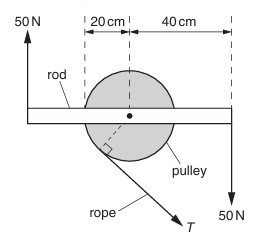
- 5. The centre of a rod is fixed to a pulley. Two 50 N forces are applied to the ends of the rod as shown. The tension in the rope attached to the pulley is T. The system is in equilibrium.
- What is the moment of the tension T about the centre of the pulley?
- A. 10 N m
- B. 20 N m
- C. 30 N m
- D. 40 N m
- Answer: D
- Explain:
- – The question states that the centre of the rod is fixed to the pulley pivot. Since the distance from the centre to the right end is 40 cm, the distance from the centre to the left end must also be 40 cm (0.4 m).
- Both 50 N forces act to rotate the rod in a clockwise direction:
- – Clockwise moment from left force = [math]50\ \text{N} \times 0.4\ \text{m} = 20\ \text{N m}[/math]
- – Clockwise moment from right force = [math]50\ \text{N} \times 0.4\ \text{m} = 20\ \text{N m}[/math]
- – Total clockwise moment = 20 + 20 = 40 N m
- For the system to remain in equilibrium, the anticlockwise moment exerted by the tension T must exactly balance this value, which equals 40 N m.
- 6. The latent heat of vaporisation of a liquid is [math]2300\ \mathrm{kJ}\ \mathrm{kg}^{-1}[/math] and it has a molar mass of 0.018 kg mol−1. What is the energy required to change 30 moles of the liquid to gas?
- A. [math]4.1 \times 10^{4}\ \text{J}[/math]
- B. [math]1.2 \times 10^{6}\ \text{J}[/math]
- C. [math]6.9 \times 10^{7}\ \text{J}[/math]
- D. [math]3.8 \times 10^{9}\ \text{J}[/math]
- Answer: B
- Explain:
- – Find total mass (m):
- [math]m = \mathrm{moles} \times \mathrm{molar\ mass}[/math]
- [math]m = 30\ \mathrm{mol} \times 0.018\ \mathrm{kg}. \mathrm{mol}^{-1}[/math]
- [math]m = 0.54\ \mathrm{kg}[/math]
- Calculate total energy (Q):
- [math]Q = m \times L_{0}[/math]
- [math]Q = 0.54\ \mathrm{kg} \times (2300 \times 10^{3}\ \mathrm{J}. \mathrm{kg}^{-1})[/math]
- [math]Q = 1,242,000\ \mathrm{J}[/math]
- [math]Q = 1.2 \times 10^{6}\ \mathrm{J}[/math]
- 7. One end of a spring is fixed and a force F is applied to its other end. The elastic potential energy in the extended spring is E. The spring obeys Hooke’s law.
- What is the extension x of the spring?
- A. [math]x = F[/math]
- B. [math]x = \frac{F}{E}[/math]
- C. [math]x = \frac{2E}{F}[/math]
- D. [math]x = \frac{F}{2E}[/math]
- Answer: C
- Explain:
- – For any spring obeying Hooke’s law, the stored elastic potential energy (E) is given by:
- [math]E = \frac{Fx}{2}[/math]
- [math]x = \frac{2E}{F}[/math]
- 8. An electron makes a transition between the two energy levels shown below.
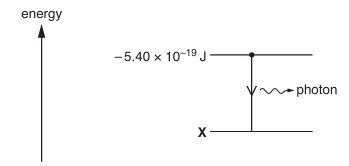
- This transition produces a photon of frequency [math]4.10 \times 10^{14}\ \text{Hz}[/math].
- What is the value of the energy level X?
- A. [math]-2.68 \times 10^{-19}\ \text{J}[/math]
- B. [math]-2.72 \times 10^{-19}\ \text{J}[/math]
- C. [math]-5.40 \times 10^{-19}\ \text{J}[/math]
- D. [math]-8.12 \times 10^{-19}\ \text{J}[/math]
- Answer: D
- Explain:
- Find the energy carried by the emitted photon ([math]\Delta E[/math]):
- [math]\Delta E = hf[/math]
- [math]\Delta E = (6.63 \times 10^{-34}\ \text{J. s})(4.10 \times 10^{-34}\ \text{Hz})[/math]
- [math]\Delta E = 2.72 \times 10^{-19}\ \text{J}[/math]
- Determine the lower state energy level (X):
- [math]X = E_{initial} – \Delta E[/math]
- [math]X = (-5.40 \times 10^{-19}) – (2.72 \times 10^{-19})[/math]
- [math]X = -8.12 \times 10^{-19}\ \text{J}[/math]
- 9. A pendulum is oscillating in air and experiences damping.
- Which of the following statements is/are correct for the damping force acting on the pendulum?
- 1. It is always opposite in direction to acceleration.
- 2. It is always opposite in direction to velocity.
- 3. It is maximum when the displacement is zero.
- A. Only 1 and 2
- B. Only 2 and 3
- C. Only 3
- D. 1, 2 and 3
- Answer: B
- Explain:
- – Statement 1 is incorrect: Damping resistive forces oppose the direction of travel, which means they are always directed opposite to velocity, not acceleration.
- – Statement 2 is correct: Frictional damping forces oppose velocity by definition.
- – Statement 3 is correct: Fluid resistance generally increases with speed. In a simple pendulum, the velocity reaches its absolute maximum when it passes through the equilibrium line (where displacement = 0). Thus, the damping force peaks at this point.
- 10. A trolley of mass M is pulled along a horizontal table by a force W provided by a mass hanging from the end of a string as shown.
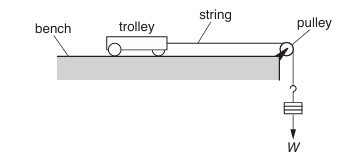
- Frictional forces are negligible. The acceleration of free fall is g.
- What is the correct equation for the acceleration a of the trolley?
- A. [math]a = \frac{W}{M}[/math]
- B. [math]a = g[/math]
- C. [math]a = \frac{W}{2M}[/math]
- D. [math]a = \frac{WW}{M+g}[/math]
- Your answer: D
- Explain:
- According to Newton’s Second Law for a connected system:
- [math]a = \frac{\text{Net Unbalanced External Force}}{\text{Total Mass of the System}}[/math]
- – The only unbalanced force pulling the system forward is the weight W of the hanging mass.
- – We can write the mass of the hanging object (m) in terms of its weight:
- [math]W = mg[/math]
- [math]m = \frac{W}{g}[/math]
- – The total combined inertia being accelerated includes both the trolley (M) and the hanging mass (m):
- [math]\text{Total Mass} =\frac{W}{M + \frac{W}{g}} [/math]
- 11. The table below shows some data on two wires X and Y.
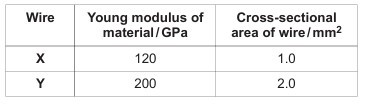
- The wires X and Y have the same original length. The tension in each wire is the same. Both wires obey Hooke’s law.
- What is the value of
- [math]\text{the ratio} \frac{\text{extension of X}}{\text{extension of Y}}[/math]
- A. 0.30
- B. 1.7
- C. 2.0
- D. 3.3
- Answer: D
- Explain:
- – Recall the formula for Young Modulus (E):
- [math]E = \frac{\text{Stress}}{\text{Strain}}[/math]
- [math]E = \frac{F/A}{x/L}[/math]
- [math]E = \frac{FL}{AX}[/math]
- Where F is tension, L is original length, A is area, and x is extension.
- [math]x = \frac{FL}{AE}[/math]
- Since the tension F and original length L are exactly the same for both wires, they cancel out when dividing:
- [math]\frac{x_X}{x_Y} = \frac{A_YE_Y}{A_XE_X}[/math]
- [math]\frac{x_X}{x_Y} = \frac{(2.0)(200)}{(1.0)(120)}[/math]
- [math]\frac{x_X}{x_Y} = 3.33[/math]
- 12. An object is dropped from rest at time [math]t = 0[/math]. It falls vertically through the air. The variation of the velocity [math]v[/math] with time [math]t[/math] is shown below.
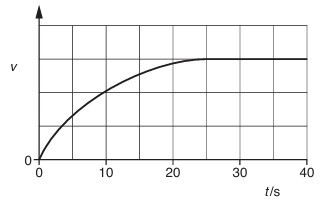
- Which statement is correct about this object?
- A. It has constant acceleration.
- B. It experiences zero drag at [math]t = 30\ \text{s}[/math].
- C. It has an acceleration of [math]9.81\ \text{m}\ \text{s}^{-2}[/math] at [math]t = 0\ \text{s}[/math].
- D. It travels the same distance in every successive [math]10\ \text{s}[/math].
- Answer: C
- Explain:
- – Why C is correct: At [math]t = 0\ \text{s}[/math], the object has just been released and its velocity is zero. Because its velocity is zero, it experiences zero air resistance (drag) at that exact instant. Therefore, the only force acting on it is gravity, causing it to accelerate at the full acceleration of free fall ([math]9.81\ \text{m}\ \text{s}^{-2}[/math]).
- – Why the others are incorrect: * A: The gradient (acceleration) changes, flattening out over time.
- B: At [math]t = 30\ \text{s}[/math], it has reached terminal velocity where drag is maximum and equal to weight.
- D: Since it speeds up significantly over the first [math]20\ \text{s}[/math], it travels much further in later intervals than in the first [math]10\ \text{s}[/math].
- 13. Earth has a mass of [math]6.0 \times 10^{24}\ \text{kg}[/math] and a radius of [math]6400\ \text{km}[/math].
- A satellite of mass [math]320\ \text{kg}[/math] is lifted from the Earth’s surface to an orbit [math]1200\ \text{km}[/math] above its surface.
- What is the change in the gravitational potential energy of the satellite?
- A. [math]9.1 \times 10^{2}\ \text{J}[/math]
- B. [math]9.9 \times 10^{6}\ \text{J}[/math]
- C. [math]3.2 \times 10^{9}\ \text{J}[/math]
- D. [math]3.8 \times 10^{9}\ \text{J}[/math]
- Your answer. C
- Explain:
- – [math]G = 6.67 \times 10^{-11}\ \text{N}.\ \text{m}^{2}.\ \text{kg}^{-2}[/math]
- – [math]M = 6.0 \times 10^{24}\ \text{kg}[/math]
- – [math]m = 320\ \text{kg}[/math]
- – Initial radius [math]r_{1} = 6400\ \text{km} = 6.4 \times 10^{6}\ \text{m}[/math]
- – Final radius [math]r_{2} = 6400\ \text{km} + 1200\ \text{km} = 7600\ \text{km}[/math]
- [math]7600\ \text{km} = 7.6 \times 10^{6}\ \text{m}[/math]
- Use the formula for change in potential energy ([math]\Delta U[/math])
- [math]\Delta U = -\frac{GMm}{r_{2}} – \left(-\frac{GMm}{r_{1}}\right)[/math]
- [math]\Delta U = GMm\left(\frac{1}{r_{1}} – \frac{1}{r_{2}}\right)[/math]
- Put Values
- [math]\Delta U = (6.67 \times 10^{-11})(6.0 \times 10^{24})(320)\left(\frac{1}{6.4 \times 10^{6}} – \frac{1}{7.6 \times 10^{6}}\right)[/math]
- [math]\Delta U = (1.2806 \times 10^{15})(2.467 \times 10^{-8})[/math]
- [math]\Delta U = 3.2 \times 10^{9}\ \text{J}[/math]
- 14. The volume of one mole of an ideal gas is [math]V[/math]. The gas exerts pressure [math]p[/math] and has thermodynamic temperature [math]T[/math]. Which of the following has the units [math]\text{J}\ \text{mol}^{-1}\ \text{K}^{-1}[/math]?
- A. [math]pV[/math]
- B. [math]\frac{P}{T}[/math]
- C. [math]\frac{V}{T}[/math]
- D. [math]\frac{pV}{T}[/math]
- Answer: D
- Explain:
- The ideal gas equation for [math]n[/math] moles is:
- [math]pV = nRT[/math]
- [math]R = \frac{pV}{nT}[/math]
- – The ideal gas constant [math]R[/math] is measured explicitly in units of [math]\text{J}\ \text{mol}^{-1}\ \text{K}^{-1}[/math].
- – Since we are given exactly [math]1[/math] mole ([math]n = 1[/math]), the expression simplifies directly to:
- [math]\frac{pV}{T}[/math]
- 15. An object oscillates with simple harmonic motion.
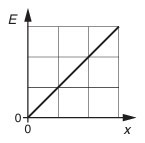
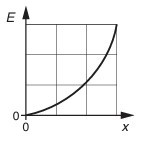
- Which graph best shows the variation of its potential energy [math]E[/math] with distance [math]x[/math] from the equilibrium position?
- A.
- B.
- C.
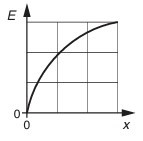
- D.
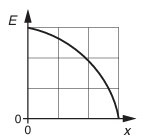
- Answer: B
- Explain:
- – In Simple Harmonic Motion, the potential energy ([math]E_{p}[/math]) of the system at any displacement [math]x[/math] from the equilibrium point is given by the square relation:
- [math]E_{p} = \frac{1}{2}kx^{2}[/math]
- – Because
- [math]E_{p} \propto x^{2}[/math]
- – The relationship must trace a parabola starting from zero at the equilibrium position ([math]x = 0[/math]). Graph B accurately showcases this quadratic curve.
-
SECTION B
-
Answer all the questions
- 16.
- (a) A tennis ball is struck with a racket.
- The initial velocity [math]v[/math] of the ball leaving the racket is [math]30.0\ \text{m}\ \text{s}^{-1}[/math] and it makes an angle of [math]70^{\circ}[/math] to the horizontal as shown in Fig. 16. Air resistance is negligible.
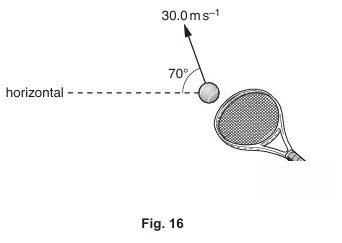 x
x- (i) Calculate the vertical component of the initial velocity of the ball.
- Explain:
- – Initial velocity ([math]v[/math]) [math]= 30\ \text{m}.\ \text{s}^{-1}[/math]
- – Angle ([math]\theta[/math]) [math]= 70^{0}[/math]
- – Calculate the vertical components ([math]v_{y}[/math]) [math]= ?[/math]
- – [math]v_{y} = v.\sin\theta[/math]
- – [math]v_{y} = 30.\sin70^{0}[/math]
- – [math]v_{y} = 30(0.9397)[/math]
- – [math]v_{y} = 28.2\ \text{m}.\ \text{s}^{-1}[/math]
- (ii) Use your answer in (i) to show that the ball reaches a maximum height [math]h[/math] of about [math]40\ \text{m}[/math].
- Explain:
- [math]v = 0\ \text{m}.\ \text{s}^{-1}[/math]
- [math]v = v_{y} = 28.2\ \text{m}.\ \text{s}^{-1}[/math]
- [math]a = -9.81\ \text{m}.\ \text{s}^{-2}[/math]
- [math]s = h\ (\text{maximum vertical height}) = ?[/math]
- [math]v^{2} = u^{2} + 2as[/math]
- [math]v^{2} = v_{y}^{2} + 2gh[/math]
- [math](0)^{2} = (28.2)^{2} + 2(-9.81)h[/math]
- [math]0 = 794.68 – 19.62h[/math]
- [math]19.62h = 794.68[/math]
- [math]h = \frac{794.68}{19.62}[/math]
- [math]h = 40.5\ \text{m}[/math]
- When an object undergoes projectile motion, its horizontal and vertical movements are entirely independent of one another:
- – Horizontal Motion: The horizontal velocity component remains completely constant throughout the flight because air resistance is negligible.
- – Vertical Motion: The ball experiences a constant downward acceleration due to gravity ([math]g = 9.81\ \text{m}.\ \text{s}^{-2}[/math]). As it ascends, gravity slows down its vertical velocity. At the absolute peak of its trajectory (maximum height [math]h[/math]), the ball stops moving upward for an instant, making its final vertical velocity
- (iii) Explain why the kinetic energy of the ball is not zero at maximum height.
- Explain:
- At maximum height, only the vertical component of the velocity becomes zero ([math]v_{y} = 0[/math]). However, the ball still possesses its constant horizontal component of velocity. Because its net velocity is not zero, its kinetic energy cannot be zero.
- Projectile motion is a combination of two independent perpendicular motions.
- – Gravity acts only vertically, which steadily slows the ball’s upward climb until it momentarily stops ascending at the absolute peak ([math]v_{y} = 0[/math]).
- – Horizontally, there are no forces acting on the ball (since air resistance is negligible). Therefore, Newton’s first law ensures that the initial horizontal velocity component [math]v_{x}[/math] remains completely unchanged throughout the entire flight.
- Because the ball is still moving sideways at the peak, it retains kinetic energy.
- (iv) The mass [math]m[/math] of the ball is [math]57.0\ \text{g}[/math].
- Calculate the kinetic energy [math]E_{k}[/math] of the ball when it is at its maximum height.
- Explain:
- – The initial launch speed [math]= v = 30\ \text{m}.\ \text{s}^{-1}[/math]
- – The launch angle [math]= \theta = 70^{0}[/math]
- – Find the constant horizontal velocity [math]= v_{x} = ?[/math]
- [math]v_{x} = v.\cos\theta[/math]
- [math]v_{x} = 30\cos70^{0}[/math]
- [math]v_{x} = 30(0.3420)[/math]
- [math]v_{x} = 10.26\ \text{m}.\ \text{s}^{-1}[/math]
- – Mass [math]= 57\ \text{g} = \frac{57}{1000} = 0.057\ \text{kg}[/math]
- – Calculate the kinetic energy [math]= ?[/math]
- [math]E_{k} = \frac{1}{2}mv_{x}^{2}[/math]
- [math]E_{k} = \frac{1}{2}(0.057)(10.26)^{2}[/math]
- [math]E_{k} = (0.0285)(105.27)[/math]
- [math]E_{k} = 3.0\ \text{J}[/math]
- (b) A metal ball is rolled off the edge of a horizontal laboratory bench. The initial horizontal velocity of the ball is [math]v[/math]. The ball travels a horizontal distance [math]x[/math] before it hits the level floor.
- Use your knowledge of projectile motion to suggest the relationship between [math]v[/math] and [math]x[/math]. Describe how an experiment can be safely conducted to test this relationship and how the data can be analysed.
- Explain:
- Theoretical Derivation:
- For a object launched horizontally from a height [math]h[/math] with an initial horizontal velocity [math]v[/math]:
- Vertical Motion:
- – The ball starts with zero initial vertical velocity ([math]v_{y} = 0[/math]) and accelerates downward due to gravity, Using the kinematic equation:
-
[math]h = v_{y}t + \frac{1}{2}gt^{2}[/math]
-
[math]h = \frac{1}{2}gt^{2}[/math]
-
[math]t = \sqrt{\frac{2h}{g}}[/math]
- – Since the height [math]h[/math] of the bench and the acceleration due to gravity [math]g[/math] remain constant throughout the experiment, the time of flight ([math]t[/math]) is constant.
- Horizontal Motion:
- – There is no horizontal acceleration because air resistance is negligible. The horizontal distance ([math]x[/math]) is given by:
- [math]x = vt[/math]
- Experimental Setup and Safety
- – To test this relationship dynamically, you need a reliable method to vary [math]v[/math] cleanly and measure [math]x[/math] safely.
- Apparatus:
- – A smooth, curved ramp (or a sloped track clamped securely to the benchtop).
- – A steel metal ball.
- – A meter rule (to measure horizontal distance).
- – Carbon paper placed over white paper on the floor (to leaves precise impact marks where the ball lands).
- – A catch-box lined with foam placed past the landing zone.
- Safety Precautions:
- Eye Protection:
- – Wear safety goggles to protect against rogue ricochets if the metal ball strikes a hard surface.
- Landing Zone Control:
- – Place a soft catch-box or foam pad at the expected landing destination to prevent the heavy ball from rolling freely across the floor, creating a tripping hazard.
- Secure Fastening:
- – Ensure the curved track is firmly clamped to the bench so it does not shift or drop mid-run.
- Experimental Procedure:
- 1. Set up the curved track so that its bottom edge terminates completely horizontally at the edge of the bench.
- 2. Mark a specific release height ([math]h_{\text{ramp}}[/math]) on the sloped track. Release the ball from rest.
- 3. The vertical drop on the ramp converts gravitational potential energy into kinetic energy.
- [math]mgh_{\text{ramp}} = \frac{1}{2}mv^{2}[/math]
- [math]v = \sqrt{2gh_{\text{ramp}}}[/math]
- Therefore, varying the release height on the ramp directly varies the initial horizontal velocity [math]v[/math].
- 4. Record the position where the ball strikes the carbon paper on the floor. Measure the horizontal distance [math]x[/math] from the plumb-line directly below the bench edge to the impact mark.
- 5. Repeat the release from the same height 3 times to calculate an average value for [math]x[/math].
- 6. Change the release height on the ramp to achieve at least 5 to 6 different values of [math]v[/math].
- Data Analysis
- To confirm the predicted relationship ([math]x \propto v[/math])
- Plotting the Graph:
- Plot a graph of horizontal distance [math]x[/math] (on the y-axis) against the initial horizontal velocity [math]v[/math] (on the x-axis).
- Expected Trend:
- – If the theory holds true, the data points should line up to form a straight line passing directly through the origin (0.0).
- Gradient Evaluation:
- – The gradient of this straight line is equal to the time of flight ([math]t[/math]). You can verify this experimental gradient by comparing it directly to the theoretical time value calculated from the measured bench height using
- [math]t = \sqrt{\frac{2h}{g}}[/math]
- 17. (a) Phobos is one of the two moons orbiting Mars. Fig. 17.1 shows Phobos and Mars.
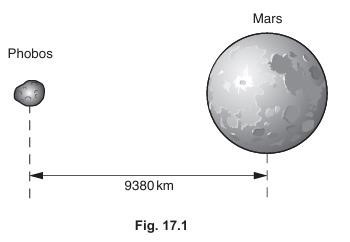
- The orbit of Phobos may be assumed to be a circle. The centre of Phobos is at a distance 9380 km from the centre of Mars and it has an orbital speed [math]2.14 \times 10^{3}\ \text{m}\ \text{s}^{-1}[/math].
(i) On Fig. 17.1, draw an arrow to show the direction of the force which keeps Phobos in its orbit.
Explain: - Centripetal Force:
- – For any object to maintain a circular or near-circular orbit, it requires a net inward force acting perpendicular to its instantaneous velocity. This is called a centripetal force, and by definition, it always points directly toward the center of the circular path.
- Gravitational Attraction:
- – In the case of a moon like Phobos orbiting a planet, this vital centripetal force is provided entirely by the gravitational pull exerted by Mars. Because gravity is an attractive force between the two masses, it pulls Phobos directly toward the center of mass of Mars.
- (ii) Calculate the orbital period T of Phobos.
- Explain:
- – Radius of phobos = [math]r = 9380\ \text{km} = 9380 \times 10^{3}\ \text{m}[/math]
- – Velocity of the object = [math]2.14 \times 10^{3}\ \text{m}\ \text{s}^{-1}[/math]
- – Calculate the orbital period = T = ?
- [math]T = \dfrac{2\pi r}{v}[/math]
- [math]T =\dfrac{2(3.14)(9380 \times 10^{3})}{2.14 \times 10^{3}}[/math]
- [math]T = 2.76 \times 10^{4}\ \text{s}[/math]
- (iii) Calculate the mass M of Mars.
- Explain:
- The gravitational force between Mars and Phobos acts entirely as the centripetal force keeping Phobos in its stable circular orbit.
- 𝐶𝑒𝑛𝑡𝑟𝑖𝑝𝑒𝑡𝑎𝑙 𝐹𝑜𝑟𝑐𝑒 = 𝐺𝑟𝑎𝑣𝑖𝑡𝑎𝑡𝑖𝑜𝑛𝑎𝑙 𝐹𝑜𝑟𝑐𝑒
- [math]\dfrac{mv^{2}}{r} = \dfrac{GMm}{r^{2}}[/math]
- [math]M = \dfrac{rv^{2}}{G}[/math]
- [math]M = \dfrac{(9380 \times 10^{3})(2.14 \times 10^{3})^{2}}{6.67 \times 10^{-11}}[/math]
- [math]M = 6.44 \times 10^{23}\ \text{kg}[/math]