
OCR A Physics OCR Paper 3 2020
- Answer all the questions.
- 1. Where appropriate, your answer should be supported with working. Marks might be given for using a correct method, even if your answer is wrong.
- Answer all the questions.
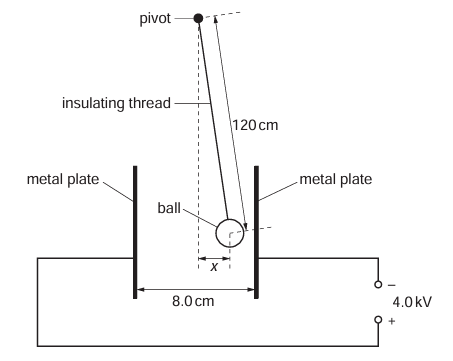
- A ball coated with conducting paint has weight 0.030 N and radius 1.0 cm. The ball is suspended from an insulating thread. The distance between the pivot and the centre of the ball is 120 cm.
- The ball is placed between two vertical metal plates. The separation between the plates is 8.0 cm. The plates are connected to a 4.0 kV power supply.
- (a) The ball receives a positive charge of 9.0 nC when it is made to touch the positive plate. It then repels from the positive plate and hangs in equilibrium at a displacement x from the vertical, as shown below. The diagram is not drawn to scale.
- i) Show that the electric force acting on the charged ball is [math]4.5 \times 10^{-4}\ \text{N}[/math].
- Explain:
- Electric Field Strength (E):
- The electric field between two parallel plates separated by distance
- [math]d = 8.0\ \text{cm} = 0.080\ \text{m}[/math]
- connected to potential difference
- [math]V = 4.0\ \text{kV} = 4000\ \text{V}[/math]
- is given by:
- [math]E = \dfrac{V}{d}[/math]
- [math]=\dfrac{4000\ \text{V}}{0.080\ \text{m}} = 50000\ \text{V m}^{-1}[/math]
- Electric Force ([math]F_E[/math]):
- The force exerted on charge
- [math]Q = 9.0\ \text{nC} = 9.0 \times 10^{-9}\ \text{C}[/math]
- is:
- [math]F_E = Q \cdot E = (9.0 \times 10^{-9}\ \text{C}) \times (50000\ \text{V m}^{-1})[/math]
- [math]= 4.5 \times 10^{-4}\ \text{N}[/math]
- ii) Draw, on the diagram above, arrows which represent the three forces acting on the ball. Label each arrow with the name of the force it represents.
- Explain:
- The three forces acting on the ball in equilibrium are:
- Weight (W):
- Directed vertically downwards from the centre of the ball (0.030 N).
- Electric Force ([math]\boldsymbol{F_E}[/math]):
- Directed horizontally to the left, away from the positive plate ([math]4.5 \times 10^{-4}\ \text{N}[/math]).
- Tension (T):
- Directed along the insulating thread towards the pivot point.
- iii) By taking moments about the pivot, or otherwise, show that x = 1.8 cm.
- Explain:
- Taking moments about the pivot in equilibrium (or using force triangle / vector equilibrium):
- [math]\tan(\theta) = \dfrac{Opposite}{Adjacent}[/math]
- [math]=\dfrac{F_E}{W}[/math]
- For small angular displacements [math]\theta[/math]:
- [math]\tan(\theta) \approx \sin(\theta)[/math]
- [math]=\dfrac{x}{L}[/math]
- where
- [math]L = 120\ \text{cm} = 1.2\ \text{m}[/math]
- is the thread length from pivot to the centre of the ball.
- [math]\dfrac{x}{L} = \dfrac{F_E}{W}[/math]
- [math]x = L \times \left(\dfrac{F_E}{W}\right) = 120\ \text{cm} \times \dfrac{4.5 \times 10^{-4}\ \text{N}}{0.030\ \text{N}}[/math]
- [math]x = 120\ \text{cm} \times 0.015 = 1.8\ \text{cm}[/math]
- b) The ball is still positively charged.
- The plates are now moved slowly towards each other whilst still connected to the 4.0 kV power supply. The plates are stopped when the separation is 5.0 cm.
- Explain the effect that this has on the deflection of the ball and explain why the ball eventually starts to oscillate between the plates.
- Explain:
- Effect on Deflection:
- As plate separation d decreases from 8.0 cm to 5.0 cm while V remains constant (4.0 kV), the electric field strength [math]E = \dfrac{V}{d}[/math] increases. Consequently, the electric force [math]F_E = QE[/math] increases, causing the horizontal deflection x of the ball to increase.
- Why Oscillation Begins:
- As x increases, the ball eventually touches the negative plate. Upon contact:
- The positively charged ball transfers its positive charge to the negative plate and acquires a negative charge.
- It is immediately repelled by the negative plate and attracted towards the positive plate.
- When it reaches and touches the positive plate, it discharges, acquires a positive charge again, and is repelled back toward the negative plate.
- This continuous charge transfer and reversal of electric force creates sustained mechanical oscillations between the plates.