
OCR A Physics OCR Paper 2 2024
-
Section A
-
You should spend a maximum of 30 minutes on this section.
-
Write your answer to each question in the box provided.
- 1. What are the base units of a kilowatt-hour?
- A. [math]J[/math]
- B. [math]kg\ m^{2}\ s^{-1}[/math]
- C. [math]kg\ m^{2}\ s^{-2}[/math]
- D. [math]W\ s[/math]
- Answer: C
- Explain:
- – A kilowatt hour (kW) is a unit of energy.
- – Energy is measured in Joules (J), where [math]1\ J = 1N.m[/math].
- – Expressing force (N) in SI base units: [math]N = kg\ m\ s^{-2}[/math].
- – Therefore, energy in SI base units is:
- [math]Base\ units = kg\ m\ s^{-2} \times m[/math]
- [math]= kg\ m^{2}s^{-2}[/math]
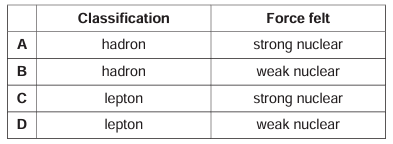
- 2. A neutrino is a fundamental particle. Which row of the table correctly describes a neutrino?
- Answer: D
- Explain:
- – Neutrinos are fundamental particles that belong to the family of leptons (they do not experience the strong nuclear force).
- – Leptons interact primarily through the weak nuclear force (and gravity).
- 3. Which one of these non-invasive medical scans does not expose the patient to ionising radiation?
- A. CAT
- B. PET
- C. Ultrasound
- D. X-ray
- Answer: C
- Explain:
- – CAT scans, PET scans, and X-rays all utilize high-energy electromagnetic radiation or positrons that ionize tissue.
- – Ultrasound uses high-frequency mechanical sound waves, which carry no ionizing radiation.
- 4. Three capacitors are arranged in a circuit.
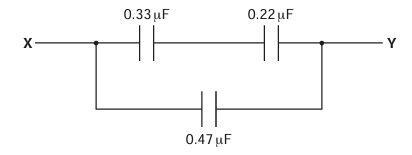
- The capacitance of each capacitor is shown.
- What is the total capacitance between X and Y?
- A. 0.25 μF
- B. 0.60 μF
- C. 1.02 μF
- D. 8.0 μF
- Answer: B
- Explain:
- The top branch has two capacitors in series:
- [math]0.33\ \mu F\ and\ 0.22\ \mu F[/math]
- [math]C_{top} = \dfrac{0.33 \times 0.22}{0.33 + 0.22}[/math]
- [math]= \dfrac{0.0726}{0.55} = 0.132\ \mu F[/math]
- The bottom branch is in parallel with the top branch and has a value of [math]0.47\ \mu\text{F}[/math].
- [math]C_{total} = C_{top} + C_{bottom}[/math]
- [math]C_{total} = 0.132 + 0.47[/math]
- [math]C_{total} = 0.602\ \mu F[/math]
- [math]C_{total} \approx 0.60\ \mu F[/math]
- 5. Y The image shows a micrometer that is being used to measure the diameter of a wire. The micrometer has a zero error of +0.07 mm. The measured value of the diameter from the micrometer scale is 2.88 mm.
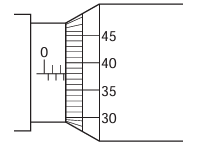
- What is the correct area of cross-section of the wire?
- A. [math]2.21 \times 10^{-6}\ m^{2}[/math]
- B. [math]6.20 \times 10^{-6}\ m^{2}[/math]
- C. [math]6.51 \times 10^{-6}\ m^{2}[/math]
- D. [math]6.84 \times 10^{-6}\ m^{2}[/math]
- Answer: B
- Explain:
- Actual Diameter Calculation:
- [math]Actual\ Diameter\ (d) = Measured\ Value – Zero\ Error[/math]
- [math]d = 2.88\ mm – 0.07\ mm = 2.81\ mm[/math]
- [math]= 2.81 \times 10^{-3}m[/math]
- Cross-Sectional Area Calculation:
- [math]A = \dfrac{\pi d^{2}}{4}[/math]
- [math]A = \dfrac{\pi \times (2.81 \times 10^{-3})^{2}}{4}[/math]
- [math]A \approx \dfrac{3.14159 \times 7.8961 \times 10^{-6}}{4}[/math]
- [math]A \approx 6.20 \times 10^{-6}m^{2}[/math]