
OCR A Physics OCR Paper 1 2019
-
SECTION A
-
You should spend a maximum of [math]30\ \text{minutes}[/math] on this section.
-
Write your answer to each question in the box provided.
-
Answer all the questions
- 1. Which set of prefixes A, B, C or D are in order of increasing magnitude?
- A. micro, milli, centi, kilo
- B. milli, centi, micro, kilo
- C. kilo, centi, milli, micro
D. centi, micro, milli, kilo - Answer: A
- Reason:
- SI prefixes values are:
- [math]\text{micro}\ (\mu)=10^{-6}=0.000001[/math]
- [math]\text{milli}\ (m)=10^{-3}=0.001[/math]
- [math]\text{centi}\ (c)=10^{-2}=0.01[/math]
- [math]\text{kilo}\ (k)=10^{3}=1000[/math]
- Increasing magnitude means smallest → largest:
- [math]\text{micro}<\text{milli}<\text{centi}<\text{kilo}[/math]
- So correct order is:
- [math]10^{-6}<10^{-3}<10^{-2}<10^{3}[/math]
- Therefore, Option A is correct.
- 2. A paper cone is held above the ground and dropped. It falls vertically and reaches terminal velocity before it hits the ground.
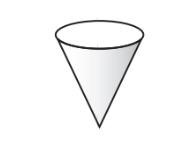
- Which statement correctly describes the resultant force on the falling cone before it reaches terminal velocity?
- A. decreasing and upwards
- B. decreasing and downwards
- C. increasing and downwards
- D. increasing and upwards
- Answer: B
- Reason:
- Forces on cone:
- – Weight acts downward (constant).
- – Air resistance acts upward.
- As speed increases:
- – Air resistance increases.
- – Resultant force decreases.
- Before terminal velocity:
- [math]\text{Weight}>\text{Air Resistance}[/math]
- So resultant force is:
- – downward
- – decreasing
- 3. A solid cylindrical glass rod has length [math]20.0\pm0.1\ \text{cm}[/math] and diameter [math]5.00\pm0.01\ \text{mm}[/math].
- What is the percentage uncertainty in the calculated volume of this rod?
- A. [math]0.1\text{%}[/math]
- B. [math]0.2\text{%}[/math]
- C. [math]0.7\text{%}[/math]
- D. [math]0.9\text{%}[/math]
- Answer: D
- Reason:
- Length [math]=l=20.0\pm0.1\ \text{cm}[/math]
- Diameter [math]=d=5.00\pm0.01\ \text{mm}[/math]
- Volume of cylinder:
- [math]V=\pi r^{2}l[/math]
- Percentage uncertainty in length:
- [math]\frac{0.1}{20.0}\times100[/math]
- [math]=0.5\text{%}[/math]
- Percentage uncertainty in diameter:
- [math]\frac{0.01}{5.00}\times100[/math]
- [math]=0.2\text{%}[/math]
- Since diameter is squared:
- [math]2(0.2\text{%})=0.4\text{%}[/math]
- Add uncertainties:
- [math]0.5\text{%}+0.4\text{%}=0.9\text{%}[/math]
- 4. A simple harmonic oscillator has maximum speed [math]24\ \text{m}\ \text{s}^{-1}[/math] and amplitude [math]5.6\ \text{cm}[/math].
- What is its angular frequency?
- A. [math]0.23\ \text{rad}\ \text{s}^{-1}[/math]
- B. [math]21\ \text{rad}\ \text{s}^{-1}[/math]
- C. [math]68\ \text{rad}\ \text{s}^{-1}[/math]
- D. [math]430\ \text{rad}\ \text{s}^{-1}[/math]
- Answer: D
- Reason:
- A simple harmonic oscillator has:
- Maximum speed [math]= 24\ \text{m}\ \text{s}^{-1}[/math]
- Amplitude [math]= 5.6\ \text{cm} = 0.056\ \text{m}[/math]
- Find angular frequency.
- For SHM:
- [math]v_{\text{max}} = \omega A[/math]
- So:
- [math]\omega = \frac{v_{\text{max}}}{A}[/math]
- Substitute values:
- [math]\omega = \frac{24}{0.056}[/math]
- [math]\omega = 428.57 \approx 430\ \text{rad}\ \text{s}^{-1}[/math]
- 5. A car is dripping oil at a steady rate on a straight road. The road is divided into four sections A, B, C, and D.
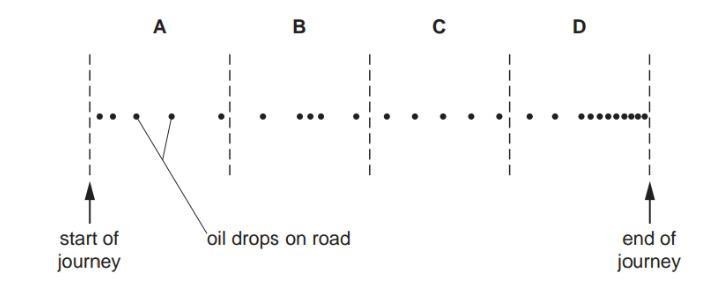
- Which section of the road shows the car travelling at a constant speed?
- Answer: C
- Reason:
- Since oil drops fall at equal time intervals, the distance between drops shows how far the car travels in equal times.
- – Large spacing = high speed
- – Small spacing = low speed
- – Equal spacing = constant speed
- In section C, the oil drops are equally spaced.
- This means:
- – In every equal time interval, the car covers the same distance.
- – So, speed is constant.
- Hence, constant speed = Section C.
- 6. The Earth is surrounded by a gravitational field.
- Which of the following statements is/are correct about the gravitational field lines near the surface of the Earth.
- 1. They are parallel.
- 2. They show the direction of the force on a small mass.
- 3. They are equally spaced.
- A. Only 1
- B. Only 1 and 2
- C. Only 2 and 3
- D. 1, 2 and 3
- Answer: D
- Reason:
- “They are parallel.”
- True
- Near Earth’s surface field lines are nearly parallel.
- “They show direction of force on a small mass.”
- True
- Field lines indicate force direction.
- “They are equally spaced.”
- True
- Uniform field → equal spacing.
- D (1, 2 and 3)