
2021
- SECTION A
- Answer ALL questions.
- All multiple choice questions must be answered with a cross in the box for the correct answer from A to D. If you change your mind about an answer, put a line through the box and then mark your new answer with a cross.
- 1. Which of the following best describes the newton as used in physical measurements?
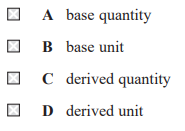
- Answer: D
- Explain:
- The newton (N) is the SI unit of force. It is defined in terms of base units of mass, length, and time as
- [math]1N = 1 kg.m.s^-2[/math]
- Because it is a combination of base units, it is a derived unit. A derived quantity is the physical property being measured (force), while a base quantity is a fundamental property like mass or length, and a base unit is its corresponding unit (kg, m, s, etc.).
- Questions 2 and 3 refer to the following information.
- A ray of light, in air, is incident on the edge of a triangular glass prism as shown. The critical angle for a light ray meeting a glass to air boundary is [math]35^0[/math].
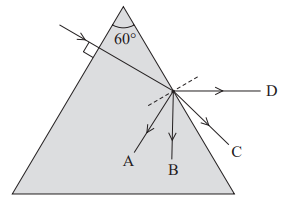
- 2. Which path, A, B, C or D, will the ray follow?
Explain: 
- Answer: B
- Explain:
- The light ray enters the first face of the prism at normal incidence (angle of incidence [math]i_1=0^0[/math]). Therefore, it passes into the glass without refraction or deviation.
- – Inside the prism, the ray travels to the second face. The angle of the prism is [math]60^0[/math]. The angle of incidence at the second face, [math]i_2[/math], can be found geometrically. The angle between the normal to the first face and the normal to the second face is equal to the apex angle of the prism, [math]60^0[/math]. Since the ray travels along the first normal, the angle of incidence at the second face is [math]i_2=60^0[/math].
- – The critical angle for the glass-to-air boundary is given as [math]c=35^0[/math].
- – Since the angle of incidence at the second face ([math]i_2=60^0[/math]) is greater than the critical angle ([math]c=35^0[/math]) the light ray undergoes total internal reflection.
- According to the laws of reflection, the angle of reflection equals the angle of incidence. The ray will be reflected internally at an angle of [math]60^0[/math] relative to the normal. Path B shows the ray being reflected back into the prism at an angle equal to the angle of incidence.
- Therefore, the ray will follow path B.
- 3. Which of the following gives the value of the refractive index of the glass?
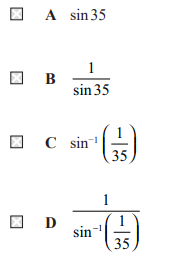
- Answer: B
- Explain:
- The critical angle ([math]\theta_c[/math]) for a boundary between two media (in this case, glass and air) is related to the refractive indices of the media ([math]n_1[/math] and [math]n_2[/math]) by the formula
- [math]\sin(\theta_c)=\frac{n_2}{n_1}[/math]
- Where [math]n_1[/math] is the refractive index of the denser medium (glass) and [math]n_2[/math] is the refractive index of the less dense medium (air). The refractive index of air is approximately [math]1.0[/math].
- – The critical angle ([math]\theta_c[/math])=[math]35^0[/math]
- – [math]n_{air}=1[/math]
- – By using the formula
- [math]\sin(\theta_c)=\frac{n_{air}}{n_{glass}}[/math]
- [math]\sin(\theta_c)=\frac{1}{n_{glass}}[/math]
- [math]n_{glass}=\frac{1}{\sin(\theta_c)}[/math]
- Questions 4 and 5 refer to the following information.
- The speed [math]v[/math] of a transverse wave on a string is given by
- [math]v=\sqrt{T/\mu}[/math]
- Where [math]\mu[/math] is the mass per unit length of the string and [math]T[/math] is the tension in the string.
- 4. [math]\mu[/math] can be calculated from measurements of the mass and length of the string.
- The percentage uncertainty in the measurement of mass is 0.4%.
- The percentage uncertainty in the measurement of length is 0.05%.
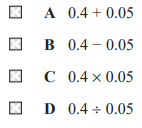
- Which of the following is the percentage uncertainty in the calculated value for [math]\mu[/math]?
- Answers: A
- Explain:
- The mass per unit length, [math]\mu[/math] is defined as the mass ([math]m[/math]) divided by the length ([math]L[/math]) of the string.
- [math]\mu=m/L[/math]
- When quantities are combined using multiplication or division, their percentage uncertainties are added. The percentage uncertainty in [math]\mu[/math] is the sum of the percentage uncertainty in mass and the percentage uncertainty in length.
- [math]\ \text{% uncertainty in }\mu=\ \text{% uncertainty in }m+\ \text{%uncertainty in }L[/math]
- Given:
- – % Uncertainty in m = 0.4 %
- – % Uncertainty in L = 0.05 %
- [math]\ \text{% uncertainty in }\mu=0.4+0.05[/math]
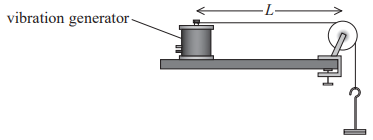
- 5. A fixed length [math]L[/math] of string is connected to a vibration generator and held under tension [math]T[/math] as shown. The frequency of the vibration generator is varied until, at a frequency [math]f[/math], a standing wave with one antinode is observed. [math]T[/math] is increased and the procedure is repeated.
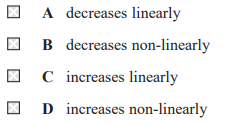
- Which of the following describes the variation in [math]f[/math] as [math]T[/math] increases?
- Answer: D
- Explain:
- The speed [math]v[/math] of a transverse wave on a string is given by the equation
- [math]v=\sqrt{T/\mu}[/math]
- Where [math]T[/math] is the tension and [math]\mu[/math] is the mass per unit length.
- For a standing wave with one antinode, the length of the string [math]L[/math] is equal to half a wavelength ([math]\lambda/2[/math])
- [math]\lambda=2L[/math]
- The wave speed is also related to frequency [math]f[/math] and wavelength [math]\lambda[/math] by the equation
- [math]v=f\lambda[/math]
- Substituting the expression for [math]\lambda[/math]:
- [math]v=f(2L)[/math]
- [math]f=v/2L[/math]
- [math]f=\frac{\sqrt{T/\mu}}{2L}[/math]
- [math]f=\frac{1}{2L\sqrt{\mu}}\sqrt{T}[/math]
- Since [math]L[/math] and [math]\mu[/math] are constant, the frequency [math]f[/math] is proportional to the square root of the tension
- [math]T(f\propto\sqrt{T})[/math]
- This relationship is non-linear, and as [math]T[/math] increases, [math]f[/math] aslo increases. Therefore, the frequency increases non-linearly.
- 6. The following measurements were made to determine the Young modulus of a metal bar.
- original length of bar = [math]0.50m[/math]
- area of cross section = [math]4.5 \times 10^{-4}[/math] [math]m^2[/math]
- tensile force applied to bar = [math]36000[/math] N
- extension of bar = [math]2.0 \times 10^{-4}[/math] m
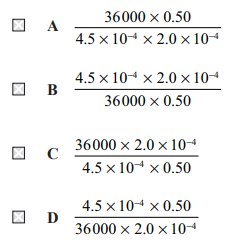
- Which of the following gives the Young modulus of the metal?
- Answer: A
- Explain:
- The Young Modulus ([math]E[/math]) is calculated using the formula:
- [math]E=\frac{\text{Tensile Stress}}{\text{Tensile Strain}}[/math]
- [math]E=\frac{F/A}{e/L}[/math]
- [math]E=\frac{FL}{Ae}[/math]
- – Area of cross section = [math]4.5 \times 10^{-4}[/math] [math]m^2[/math]
- – Tensile force applied to bar = [math]36000[/math] N
- – Extension of bar = [math]2.0 \times 10^{-4}[/math] m
- – Original length of bar = [math]0.50[/math] m
- [math]E=\frac{FL}{Ae}[/math]
- [math]E=\frac{(36000)(0.50)}{(4.5\times10^{-4})(2.0\times10^{-4})}[/math]
- 7. The diagram shows the position of two particles, X and Y, on a transverse wave. The wave is travelling from left to right.
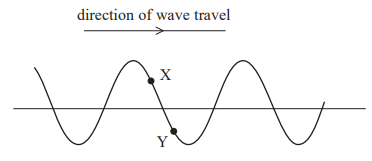
- Which of the following describes the directions in which the particles at X and Y are moving at the instant shown?
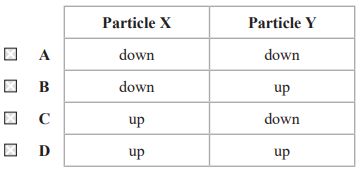
- Answer: D – Down up
- Explain:
- – A transverse wave transfers energy perpendicular to the direction of particle oscillation. The wave in the diagram is moving from left to right.
- – To determine the direction of the particles at the instant shown, imagine the shape of the wave a moment later.
- – For particle X, the wave’s crest is moving towards it from the left. In the next instant, the part of the wave to the right of X will move into X’s current position, which is lower than X. Therefore, particle X is moving down.
- – For particle Y, the wave’s trough is moving away from it to the right. In the next instant, the part of the wave to the left of Y will move into Y’s current position, which is higher than Y. Therefore, particle Y is moving up.
- – Thus, particle X is moving down and particle Y is moving up, which corresponds to option B.
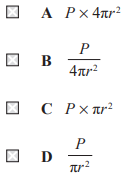
- 8. A beam of light from a torch with power P is shone onto a surface. The light is spread over a circular area with a radius r.
- Which of the following gives the intensity of the light on the surface?
- Answer: D
- Explain:
- The intensity of light is defined as the power per unit area. The total power P from the torch is spread over a circular area with radius r. The area of this circle is given by the formula
- [math]A=\pi r^2[/math]
- Therefore, the intensity I of the light on the surface is calculated using the formula:
- Intensity=Power/Area
- [math]I=\frac{P}{\pi r^2}[/math]
- 9. In an investigation to determine the speed of sound in air, a student sets up an oscilloscope to display the waveform of a sound wave as shown.
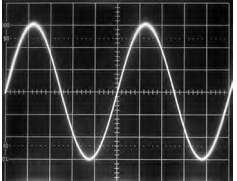
- The time – base is set to 25µs/division.
- Determine the frequency of the sound wave. (2)
- Explain:
- – The time – base is set = [math]25\times10^{-6}[/math] s
- – The frequency of the sound wave = [math]f=?[/math]
- [math]T=\text{number of division per cycle}\times\text{time per division}[/math]
- [math]T=4\times25\times10^{-6}[/math]
- [math]T=100\times10^{-6}[/math] s
- [math]f=\frac{1}{T}[/math]
- [math]f=\frac{10^{6}}{100}[/math]
- [math]f=10000\ \text{Hz}[/math]
- [math]f=10\ \text{kHz}[/math]
- Frequency = [math]f=10\ \text{kHz}[/math]
- (b) The student sets the timebase on the oscilloscope to a lower value per division. Describe any changes to the appearance of the waveform on the screen.
- Explain:
- The waveform will appear to be more spread out or stretched horizontally across the screen.
- The timebase setting on an oscilloscope determines the duration of time represented by each horizontal division on the screen. When the timebase value is lowered a shorter amount of time is displayed per division.
- Consequently, more divisions are needed to display one complete cycle of the wave, making the entire waveform appear horizontally stretched or expanded on the screen. The amplitude (vertical size) of the waveform remains unchanged.
- 10. Concrete is a material used in buildings due to its high compressive strength.
- (a) A concrete post can be checked for internal cracks using a pulse-echo technique. A transducer that transmits and receives ultrasound pulses is positioned against the side of the post as shown.
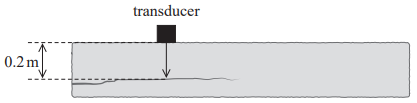
- A pulse hits a crack and is reflected and is then detected by the transducer.
- Deduce whether a crack at a depth of 0.2m can be detected.
- – time between pulses = 160 µs
- – speed of sound in concrete = [math]3200 ms^{−1} [/math](3)
- Explain:
- – The total distance = [math]d=2\times0.2=0.4[/math] m
- – Speed = [math]3200[/math] m/s
- – Calculate the time in micro meter = [math]t=?[/math]
- time=distance/speed
- [math]time=\frac{0.4}{3200}[/math]
- [math]t=0.000125[/math] s
- [math]t=125\times10^{-6}[/math] s
- [math]t=125\ \mu s[/math]
- (b) Another concrete post is reinforced with steel rods, to increase its tensile strength.
- A steel rod is under a tensile load of 130N and extends by [math]4\times10^{-4}m[/math]. The steel has not reached its elastic limit.
- – Calculate the elastic strain energy in the steel rod. (2)
- Explain:
- – Force = [math]F=130[/math] N
- – Extension, [math]x=4\times10^{-4}[/math] m
- – The elastic strain energy = [math]W=?[/math]
- [math]W=\frac{1}{2}Fx[/math]
- [math]W=\frac{1}{2}(130)(4\times10^{-4})[/math]
- [math]W=(0.5)(130)(0.0004)[/math]
- [math]W=0.026[/math] J
- Elastic strain energy = [math]W=0.026[/math] J
- 11. An electron in its ground state absorbs electromagnetic radiation of wavelength λ. The energy level diagram represents the resulting energy transition of the electron.
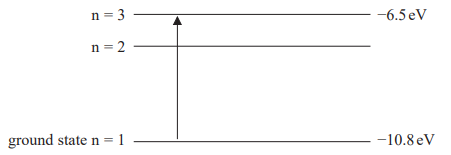
- (a) Calculate the wavelength of radiation absorbed by the electron.
- Explain:
- – Calculate the energy difference = [math]\Delta E=?[/math]
- – The final state is = [math]n=3[/math]
- – The initial state is = [math]n=1[/math]
- [math]\Delta E=E_{final}-E_{initial}[/math]
- [math]\Delta E=-6.5-(-10.8)[/math]
- [math]\Delta E=4.3[/math] eV
- [math]1\ \text{eV}=1.602\times10^{-19}[/math] V
- [math]\Delta E=4.3\ \text{eV}\times1.602\times10^{-19}[/math] J/eV
- [math]\Delta E=6.9\times10^{-19}[/math] J
- [math]\Delta E=\frac{hc}{\lambda}[/math]
- [math]\lambda=\frac{hc}{\Delta E}[/math]
- [math]\lambda=\frac{(6.63\times10^{-34})(3\times10^{8})}{6.9\times10^{-19}}[/math]
- [math]\lambda=\frac{(1.989\times10^{8})}{6.9\times10^{-19}}[/math]
- [math]\lambda=2.9\times10^{-7}[/math] m
- Wavelength = [math]\lambda=2.9\times10^{-7}[/math] m
- (b) The electron eventually returns to its ground state.
- Explain, with reference to the energy level diagram, how this may result in the emission of radiation with a longer wavelength than λ.
- Explain:
- The electron can return to the ground state via an intermediate transition to the [math]n=2[/math] state, followed by a transition to the [math]n=1[/math] state. This two-step process involves emitting two photons, each with lower energy and thus a longer wavelength than the single photon absorbed during the initial excitation.
- The initial absorption of radiation with wavelength [math]\lambda[/math] excites the electron from the ground state ([math]n=1[/math]) to then [math]n=3[/math] state. The energy of this absorbed photon is equal to the energy difference between these two levels:
- [math]E_{absorbed}=E_3-E_1[/math]
- The energy of a photon is inversely proportional to its wavelength given by the equation
- [math]E=\frac{hc}{\lambda}[/math]
- Therefore, the absorbed photon has an energy of:
- [math]E_{absorbed}=E_3-E_1[/math]
- [math]E_{absorbed}=-6.5\ \text{eV}-(-10.8\ \text{eV})[/math]
- [math]E_{absorbed}=4.3\ \text{eV}[/math]
- When the electron de-excites, it can return to the ground state in a single step (emitting a photon with energy [math]4.3\ \text{eV}[/math] and wavelength [math]\lambda[/math]) or in multiple steps. A possible multiple-step path is:
- – Transition from [math]n=3[/math] to [math]n=2[/math]:
- A photon is emitted with energy[math]E_{(3\rightarrow2)}=E_3-E_2[/math]
- – Transition from [math]n=2[/math] to [math]n=1[/math]:
- A second photon is emitted with energy[math]E_{(2\rightarrow1)}=E_2-E_1[/math]
- For the emission to have a longer wavelength than [math]\lambda[/math] the emitted photon must have a lower energy than [math]E_{absorbed}[/math]. The two-step process results in two photons, each with an energy less than [math]E_{absorbed}[/math]:
- [math]E_{(3\rightarrow2)}<4.3\ \text{eV}[/math]
- [math]E_{(2\rightarrow1)}<4.3\ \text{eV}[/math]
- 12. Vibrations of a car engine cause a sound wave in air.
- (a) Describe how the displacement of air molecules causes pressure variations in the air. (3)
- Explain:
- Sound waves are longitudinal waves in which air molecules vibrate parallel to the direction of wave propagation.
- As the engine vibrates, it pushes nearby air molecules, creating a region of compression where molecules are closer together than normal. This results in an increase in air pressure.
- The engine then moves in the opposite direction, pulling air molecules apart and creating a region of rarefaction where molecules are spread further apart. This results in a decrease in air pressure.
- These alternating regions of high pressure (compressions) and low pressure (rarefactions) propagate through the air as a sound wave, causing pressure variations.
- The frequency of these pressure variations corresponds to the frequency of the engine’s vibrations.
- (b) A silencer is a device fitted to a car to reduce the sound from the engine. Some sound passes through the silencer chamber and is reflected twice. Some sound passes straight through the chamber without being reflected.
- The simplified diagram shows the paths of the sound as it travels through the chamber. Sound leaving the chamber is a combination of sound waves from the two paths. The sound waves are in phase as they enter the chamber.
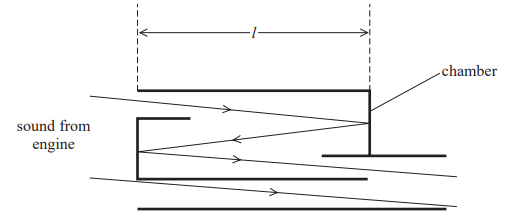
- An engine produces sound with a frequency of about [math]140\ \text{Hz}[/math].
- Explain why, to reduce this sound, the length [math]l[/math] of the chamber should be about [math]60\ \text{cm}[/math].
- speed of sound in air = [math]340\ \text{m s}^{-1}[/math] (4)
- Explain:
- – The speed of sound = [math]v=340\ \text{m s}^{-1}[/math]
- – The frequency = [math]f=140\ \text{Hz}[/math]
- – Calculate the wavelength = [math]\lambda=?[/math]
- [math]\lambda=\frac{c}{f}[/math]
- [math]\lambda=\frac{340}{140}[/math]
- [math]\lambda=2.43\ \text{m}[/math]
- – The extra distance traveled by the upper path = [math]2l[/math]
- [math]2l=\frac{\lambda}{2}[/math]
- [math]l=\frac{\lambda}{4}[/math]
- [math]l=\frac{2.43}{4}[/math]
- [math]l=0.6075\ \text{m}[/math]
- [math]l=0.6075\times100\ \text{cm}[/math]
- [math]l=60.75\ \text{cm}[/math]