
24 May 2023

- SECTION A
- Answer ALL questions.
- All multiple choice questions must be answered with a cross in the box for the correct answer from A to D. If you change your mind about an answer, put a line through the box and then mark your new answer with a cross.
- 1. The wavelength of light emitted from a laser can be determined using a diffraction grating. The equation used to calculate the wavelength is
- [math]n\lambda=d\sin\theta[/math]
- Which row of the table shows possible units for n and d?
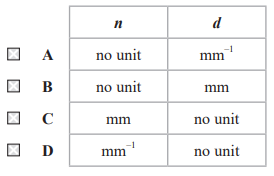
- Answer: B
- Explain:
- The equation is
- [math]n\lambda=d\sin\theta[/math]
- – [math]\lambda[/math] (wavelength) and [math]d[/math] (distance between slits) are both measures of length, so they have the same units (e.g., mm, m, or nm).
- – [math]\sin\theta[/math] is a ratio of lengths and therefore has no units.
- – [math]n[/math] is the order of the diffraction maximum (e.g., 1st order, 2nd order) and is a dimensionless quantity, meaning it also has no units.
- 2. A student carries out an investigation to determine the Young modulus of a material. Which of the following gives two measuring instruments the student should use?
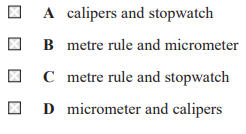
- Answer: B
- Explain:
- To determine the Young modulus of a material, measurements of length, diameter, and extension are required.
- – A metre rule is typically used to measure the overall length of the material (e.g., a wire) and the extension.
- – A micrometer screw gauge is used to measure the diameter of the wire accurately, as the diameter is usually small and requires a high degree of precision.
- – Calipers could also be used for measuring length or diameter, but a micrometer is more suitable for the small diameter of a wire.
- – A stopwatch is used for measuring time, which is not a required measurement for determining the Young modulus in a static test.
- 3. A 2 beam oscilloscope is used to determine the speed of sound in air. The oscilloscope screen shown displays the signal used to produce the sound wave.
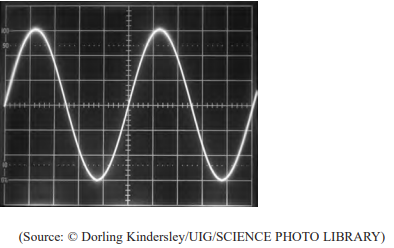
- The time base is set to [math]50\mu s[/math]/division.
- Which of the following gives the frequency, in Hz, of the signal?
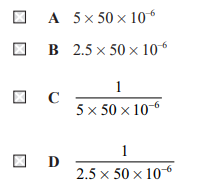
- Answer: C
- Explain:
- The period ([math]T[/math]) of the wave is the time taken for one complete oscillation. On the oscilloscope screen, one full wave cycle covers [math]5[/math] horizontal divisions. The time-base setting is [math]50\mu s[/math]/division which is [math]50 \times 10^{-6}[/math] s/division.
- The period is calculated as:
- [math]T=\text{number of divisions}\times\text{time-base setting}[/math]
- [math]T=5\text{ divisions}\times 50\times 10^{-6}\text{ s/division}[/math]
- [math]T=5\times 50\times 10^{-6}\text{ s}[/math]
- Calculate the frequency
- The frequency ([math]f[/math]) is the reciprocal of the period:
- [math]f=\frac{1}{T}[/math]
- [math]f=\frac{1}{5\times 50\times 10^{-6}}\text{ Hz}[/math]
- 4. A ball bearing falling freely through a liquid reaches terminal velocity. The terminal velocity is determined by measuring the time taken for the ball bearing to fall a measured distance.
- The measured distance has a percentage uncertainty X.
- The measured time has a percentage uncertainty Y.
- Which of the following gives the percentage uncertainty in the value for the terminal velocity of the ball bearing?
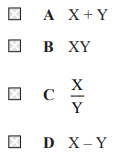
- Answer: A
- Explain:
- The terminal velocity ([math]v[/math]) is calculated using the formula
- [math]v=\frac{d}{t}[/math]
- Where [math]d[/math] is the distance and [math]t[/math] is the time.
- When quantities are multiplied or divided, their percentage uncertainties are added together. The percentage uncertainty in distance is X, and the percentage uncertainty in time is Y. Therefore, the percentage uncertainty in the terminal velocity is the sum of these individual percentage uncertainties.
- 5. A lamp is switched on and viewed through two polarising filters P and Q, as shown

- The lamp appears dark when viewed through P and Q. Q is rotated through [math]180^\circ[/math].
- Which row of the table gives the appearance of the lamp after Q has rotated by [math]90^\circ[/math] from its original position and by [math]180^\circ[/math] from its original position?
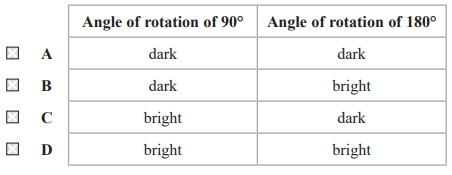
- Answer: C
- Explain:
- The initial condition states the lamp appears dark when viewed through both filters P and Q, meaning the transmission axes of the two polarizers are perpendicular to each other (crossed).
- – When filter Q is rotated by [math]90^\circ[/math] from its original, crossed position, its transmission axis becomes parallel to filter P’s axis. This allows the maximum amount of polarized light from P to pass through Q, making the lamp appear bright.
- – When filter Q is rotated by [math]180^\circ[/math] from its original position, its transmission axis is once again perpendicular to filter P’s axis (the same orientation as the initial condition). This blocks the light, making the lamp appear dark.
- 6. A textbook describes waves as having oscillations of different wavelengths in multiple planes. The oscillations are perpendicular to the direction of energy transfer.
- Which of the following is being described?
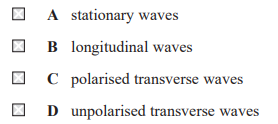
- Answer: D
- Explain:
- A transverse wave is defined by oscillations that are perpendicular to the direction of energy transfer. Both polarised and unpolarised transverse waves fit this description. The key difference is that a polarised wave has oscillations restricted to a single plane, while an unpolarised wave has oscillations in multiple planes.
- Since the description mentions oscillations occurring in “multiple planes”, the wave being described is an unpolarised transverse wave.
- 7. Two thin converging lenses are placed next to each other as shown.
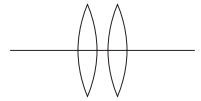
- Each lens has a power of [math]4D[/math].
Which of the following is the total power of the combined lenses? 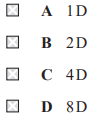
- Answer: 8D
- Explain:
- When thin lenses are placed in contact with each other, the total power of the combination is the algebraic sum of their individual powers. The formula is given by:
- [math]P_{\text{total}}=P_1+P_2+P_3+\cdots[/math]
- Each lens has a power of [math]4D[/math]. There are two such lenses.
- [math]P_1=4D[/math]
- [math]P_2=4D[/math]
- [math]P_{\text{total}}=4D+4D[/math]
- [math]P_{\text{total}}=8D[/math]
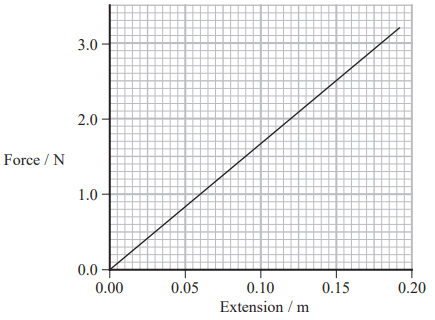
- 8. A force extension graph for a spring is shown.
- Which of the following gives the work done, in joules, in extending the spring by 0.15m from its original length?
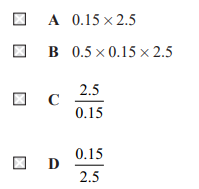
- Answer: B
- Explain:
From the graph, the force (F) corresponding to an extension (x) of 0.15 m is [math]2.5\ m[/math]
The work done (W) in extending a spring is equal to the area under the force-extension graph, which is the area of a triangle - [math]Work\ done=\frac{1}{2}\times extension\times force[/math]
[math]Work\ done=\frac{1}{2}\times 0.15\times 2.5[/math]
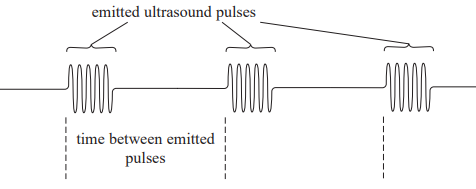
[math]Work\ done=0.5\times 0.15\times 2.5[/math] - 9. Bats use a pulse echo technique to hunt for moths. The bat emits a series of ultrasound pulses as shown on the oscilloscope trace below.
- a) A stationary bat emits an ultrasound pulse that is reflected from a moth. The bat detects the reflected pulse 36ms later.
Calculate the distance between the bat and the moth. (3) - speed of sound = [math]340\ ms^{-1}[/math]
- Explain:
– Time taken for the pulse to reflect back to the bat, [math]t=36\ ms=36\times 10^{-3}\ s[/math] - – Speed of sound = [math]340\ ms^{-1}[/math]
- – Calculate the distance between the bat and the moth = [math]d=?[/math]
- [math]2d=v\times t[/math]
[math]2d=340\times 36\times 10^{-3}[/math]
[math]2d=12.24\ m[/math]
[math]d=\frac{12.24}{2}\ m[/math]
[math]d=6.1\ m[/math] - b) The bat flies towards the moth.
- Explain why the bat must change the time between the emitted pulses as the distance between the bat and the moth decreases.
- Explain:
The time between pulses must decrease to ensure the echo from the previous pulse is received before the next pulse is emitted.
– Bats use the pulse-echo technique to locate objects by emitting an ultrasound pulse and listening for the echo.
– The time it takes for the echo to return is proportional to the distance to the moth.
– As the distance between the bat and the moth decreases, the time taken for the echo to return also decreases.
– To avoid confusion between the returning echo of one pulse and the emission of the next pulse, the bat must reduce the time between emitted pulses.
– This allows the bat to accurately interpret the echo signals and track the moth’s movement. - 10. The speed of the blood in a blood vessel can indicate a person’s health. A high speed may indicate a high stress on the walls of the blood vessel.
- a) The speed [math]v[/math] of the blood in a blood vessel with a diameter [math]d[/math] is given by
- [math]v=\frac{k\eta}{\rho d}[/math]
- where [math]\eta[/math] is the viscosity of the blood
[math]\rho[/math] is the density of the blood
[math]k[/math] is a constant with no units. - Show that the unit for [math]\eta[/math] is [math]Pa\ s[/math]. (3)
- Explain:
The given formula is - [math]v=\frac{k\eta}{\rho d}[/math]
- [math]\eta=\frac{v\rho d}{k}[/math]
- – [math]v\ (speed):m/s=m.s^{-1}[/math]
– [math]\rho\ (density):kg/m^3=kg.m^{-3}[/math]
– [math]d\ (diameter/length):m - – k (constant with no units): No units
- [math]\eta=\frac{v\rho d}{k}[/math]
[math]\eta=((m.s^{-1})(kg.m^{-3})(m))/1[/math]
[math]\eta=kg.m^{-1}s^{-1}[/math] - Convert the base units to Pascal-seconds ([math]Pa\ s[/math])
- [math]Pa=N/m^2[/math]
[math]Pa=\frac{kg.m.s^{-2}}{m^2}[/math]
[math]Pa=kg.m^{-1}s^{-1}[/math] - b) As the speed of the blood changes, the wall of the blood vessel expands and contracts.
- The wall of a blood vessel consists of collagen fibres.
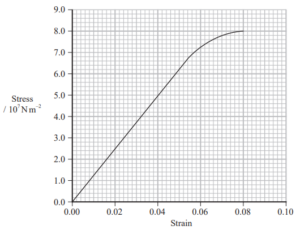
- The graph shows the stress strain relationship up to the breaking stress of the collagen fibres.
- i) Calculate the Young modulus of collagen fibres. (2)
- Explain:
– A clear point on this linear section is at a stress = [math]6.0\times 10^7\ N.m^{-2}[/math] - – Strain = [math]0.05[/math]
- – Calculate the Young modulus of collagen fibres = [math]E=?[/math]
- [math]Young\ modulus=\frac{Stress}{Strain}[/math]
[math]Young\ modulus=\frac{6.0\times 10^7}{0.05}[/math]
[math]Young\ modulus=1.2\times 10^9\ N.m^{-2}[/math] - ii) Describe the behaviour of collagen fibres when the stress in the fibres is increased from the elastic limit until the fibres break.
- Explain:
Stress and strain are no longer proportional, and the fibres are stretched irreversibly.
– Beyond the elastic limit (around strain of [math]0.04[/math] and stress of [math]4.0\ N.m^{-2}[/math] the fibre no longer obeys Hooke’s law, as the relationship between stress and strain becomes non-linear.
– The fibres undergo plastic deformation, meaning they are stretched irreversibly and will not return to their original length if the stress is removed.
– The gradient of the graph (stiffness) decreases, indicating that a smaller increase in stress results in a larger increase in strain, or the collagen fibres become less stiff.
– The collagen fibres break when the stress reaches approximately [math]8.0\ N.m^{-2}[/math] (or strain of approximately [math]0.08[/math]), which is the breaking stress (or ultimate tensile strength) shown in the graph.
- 11. In a demonstration of the photoelectric effect, electromagnetic radiation of frequency [math]f[/math] was incident on the surface of a metal. The maximum kinetic energy [math]E_{max}[/math] of the emitted photoelectrons was determined for increasing values of [math]f[/math].
- (a) No photoelectrons are emitted when the frequency of the radiation is below a certain value. Explain why. (3)
- Explain:
- No photoelectrons are emitted when the frequency of the radiation is below the threshold frequency because the energy of the incident photons is less than the work function of the metal.
- – Electromagnetic radiation is quantised into photons, and each electron in the metal absorbs a single photon.
- – The energy of a single photon ([math]E[/math]) is directly proportional to its frequency ([math]f[/math]) as described by the equation
- [math]E=hf[/math]
- Where [math]h[/math] is Planck’s constant.
- – Electrons are bound within the metal by attractive forces and require a minimum amount of energy to escape the surface. This minimum energy is called the work function ([math]\phi[/math]) of the metal.
- – If the frequency of the incident radiation is below a certain threshold value ([math]f_0[/math]), the energy of each individual photon ([math]hf[/math]) is less than the work function.
- – Therefore, even if the intensity of the radiation is high, individual electrons do not gain sufficient energy to overcome the binding forces and be released from the metal surface.
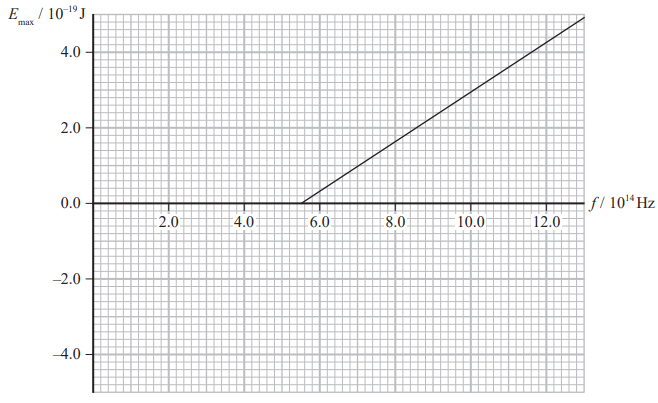
- (b) The graph shows the variation of [math]E_{max}[/math] with [math]f[/math].
- (i) A photon with frequency [math]10.0\times 10^{14}[/math] Hz is incident on the metal surface causing a photoelectron to be released. Calculate the maximum possible velocity [math]v_{max}[/math] of the photoelectron. (2)
- Explain:
- – The maximum kinetic energy = [math]E_{max}=2.9\times 10^{-19}[/math] J
- – Frequency = [math]f=10.0\times 10^{14}[/math] Hz
- – The mass of the electron = [math]9.11\times 10^{-31}[/math] kg
- – Calculate the maximum velocity = [math]v_{max}=?[/math]
- [math]E_{max}=\frac{1}{2}mv_{max}^2[/math]
- [math]v_{max}=\sqrt{\frac{2E_{max}}{m}}[/math]
- [math]v_{max}=\sqrt{\frac{2(2.9\times 10^{-19})}{9.11\times 10^{-31}}}[/math]
- [math]v_{max}=\sqrt{\frac{2(2.9\times 10^{-19})}{9.11\times 10^{-31}}}[/math]
- [math]v_{max}=7.98\times 10^5[/math] m.s[math]^{-1}[/math]
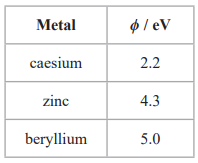
- (ii) The table shows the work function [math]\phi[/math] for three metals.
- Deduce which metal was used in this demonstration.
- Explain:
- – The photoelectric equation
- [math]E_{max}=hf-\Phi[/math]
- – The graph shows the variation of [math]E_{max}[/math] with frequency [math]f[/math]. The x-intercept of the graph corresponds to the threshold frequency [math]f_0[/math] where [math]E_{max}=0[/math]
- – From the graph, the line crosses the x-axis (where [math]E_{max}=0[/math]) at [math]f_0=5.0\times 10^{14}[/math] Hz
- [math]E_{max}=hf_0-\Phi[/math]
- [math]0=hf_0-\Phi[/math]
- [math]\Phi=hf_0[/math]
- [math]\Phi=(6.63\times 10^{-34})(5.0\times 10^{14})[/math]
- [math]\Phi=3.315\times 10^{-19}[/math] J
- [math]\Phi=\frac{3.315\times 10^{-19}\text{ J}}{1.6\times 10^{-19}\text{ J/eV}}[/math]
- [math]\Phi=2.07[/math] eV
- The calculated work function value of approximately [math]2.07[/math] eV is closest to the work function of caesium ([math]2.2[/math] eV) in the table.
- 12. A student was studying musical instruments.
- (a) The student set up a standing wave on a string using the apparatus shown.
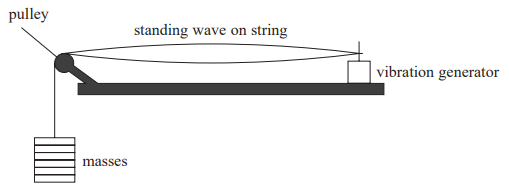
- The standing wave had one antinode, as shown above, when the vibration generator had a frequency [math]f[/math].
- The student then increased the frequency.
- Describe what was observed as [math]f[/math] was gradually increased to [math]2f[/math]. (2)
- Explain:
- The string will appear blurred and then a new standing wave with two antinodes will form at frequency [math]2f[/math].
- – The initial standing wave with one antinode represents the fundamental frequency, [math]f[/math]. The length of the string [math]L[/math] is equal to half a wavelength ([math]\lambda/2[/math]).
- – The next possible standing wave (the first overtone or second harmonic) forms when the frequency is doubled to [math]2f[/math], and the string length is equal to one full wavelength.
- – As the frequency is gradually increased from [math]f[/math] to [math]2f[/math], the standing wave pattern is disrupted, and the string vibrates erratically or appears blurred because the conditions for resonance are not met. The string only forms a stable, clear standing wave pattern at specific resonant frequencies, which are integer multiples of the fundamental frequency ([math]f,2f,3f[/math] etc.) At [math]2f[/math], a new stable standing wave pattern with two antinodes and one additional node in the middle will appear.
- (b) A guitar has metal strings under tension. When a string is plucked it vibrates, producing a sound wave in the air. Describe how the vibrating string produces pressure variations in the air. (3)
- Explain:
- Describe how the vibrating string produces pressure variations in the air
- The vibrating string causes adjacent air particles to vibrate, creating areas of high pressure (compressions) and low pressure (rarefactions) that propagate outwards as a sound wave.
- When the string moves in one direction, it pushes nearby air particles, increasing the local pressure and creating a compression.
- When the string moves back in the opposite direction, it pulls the adjacent air particles, decreasing the local pressure and creating a rarefaction. These compressions and rarefactions travel through the air as a longitudinal wave, which is the sound wave.
- (c) A guitar player changes the length of string that vibrates by pressing on the string as shown.

- The guitar player plucks a string to play a note. A standing wave with one antinode is set up on the string.
- He can vary the length of string that vibrates from [math]21cm[/math] to [math]63cm[/math].
- Deduce whether a note of frequency [math]196Hz[/math] can be played on the string.
- tension in string = [math]56N[/math]
- mass per unit length of the string = [math]5.0\times 10^{-3}[/math] kgm[math]^{-1}[/math] (4)
- Explain:
- – The tension = [math]T=56[/math] N
- – Calculate the wave speed on the string = [math]v=?[/math]
- [math]v=\sqrt{\frac{T}{\mu}}[/math]
- [math]v=\sqrt{\frac{56}{5.0\times 10^{-3}}}[/math]
- [math]v=\sqrt{11200}[/math]
- [math]v=105.83[/math] ms[math]^{-1}[/math]
- – The maximum length = [math]L_{max}=0.21[/math] m
- [math]f_{max}=\frac{v}{2L_{max}}[/math]
- [math]f_{max}=\frac{105.83}{2(0.21)}[/math]
- [math]f_{max}=251.98[/math] Hz
- The target frequency is [math]196[/math] Hz. This value falls within the calculated range of possible frequencies
- [math]84Hz\leq 196Hz\leq 252Hz[/math]
- Yes, a note of frequency [math]196Hz[/math] can be played on the string because this frequency is within the range of fundamental frequencies achievable by varying the string length from [math]21[/math] cm to [math]63[/math] cm.