
15 May 2020
-
SECTION A
-
Answer ALL questions.
- All multiple-choice questions must be answered with a cross in the box for the correct answer from A to D. If you change your mind about an answer, put a line through the box and then mark your new answer with a cross.
- 1. Which of the following is a S.I. base quantity?
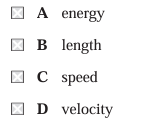
- Answer: B
- Explain:
- The International System of Units (SI) defines seven fundamentals, or “base,” quantities that are considered to be a basic set from which all other units can be derived.
- The seven SI base quantities are:
- – Time (unit: second)
- – Length (unit: meter)
- – Mass (unit: kilogram)
- – Electric current (unit: ampere)
- – Thermodynamic temperature (unit: kelvin)
- – Amount of substance (unit: mole)
- – Luminous intensity (unit: candela)
- Other quantities like energy, speed, and velocity are considered “derived quantities” because they can be expressed as combinations of the base quantities. For example:
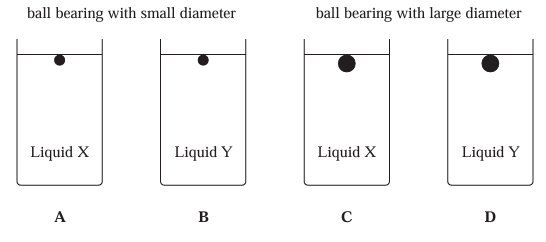
- 2. In a falling-ball method to investigate the viscosity of a liquid, ball bearings with two different diameters are allowed to fall through two different liquids, X and Y. The viscosity of liquid X is greater than the viscosity of liquid Y. In which set-up shown below will the ball bearing have the greatest terminal velocity?

- Answer: D
- Explain:
- The terminal velocity of a spherical object falling through a viscous fluid is given by the formula:
- [math]v_t = \frac{2}{9}\,\frac{r^2 g (\rho_P – \rho_f)}{\eta}[/math]
- Where:
- – [math]v_t[/math] is the terminal velocity
- – r is the radius of the sphere
- -g is the acceleration due to gravity
- – [math]\rho_p[/math] is the density of the sphere
- – [math]\rho_f[/math] is the density of the fluid
- – [math]\eta[/math] is the dynamic viscosity of the fluid
- To have the greatest terminal velocity, we need to maximize the numerator and minimize the denominator in the formula.
- -The terminal velocity is directly proportional to the square of the radius
- [math]v_t \alpha r^2[/math]
- Therefore, a ball bearing with a large diameter will have a greater terminal velocity.
- – The terminal velocity is inversely proportional to the viscosity of the fluid
- [math]v_t \propto \frac{1}{\eta}[/math]
- Therefore, the ball bearing will have a greater terminal velocity in the liquid with the lower viscosity.
- The problem states that the viscosity of liquid Y is less than the viscosity of liquid X.
- Combining these two factors, the greatest terminal velocity will be achieved with the ball bearing with the large diameter in liquid Y. This corresponds to set-up D.
- 3. A light source radiates a power P onto a surface, covering a circular area of radius r.
- Which of the following is the correct expression for the intensity I of the radiation at the surface?
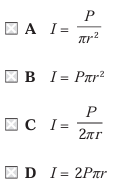
- Answer: A
- Explain:
- – The intensity of radiation (I) is defined as the power (P) per unit area (A). This can be expressed by the formula:
- [math]I = \frac{P}{A}[/math]
- The problem states that the radiation covers a circular area with a radius (r). The formula for the area of a circle is:
- [math]A = \pi r^2[/math]
- To find the correct expression for the intensity, substitute the area of the circle into the intensity formula:
- [math]I = \frac{P}{\pi r^2}[/math]
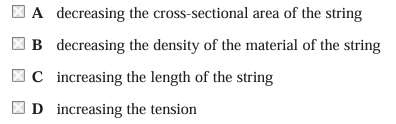
- 4. A string is held under tension. When it is plucked it vibrates with a frequency f. Which of the following would result in a lower value for f ?
- Answer: C
- Explain:
- String Vibration Frequency
- The fundamental frequency (f) of a vibrating string is given by the formula:
- [math]f = \frac{1}{2L}\sqrt{\frac{T}{\mu}}[/math]
- – L is the length of the string
- – T is the tension in the string
- – [math]\mu[/math](mu) is the linear mass density of the string (mass per unit length)
- From this formula, the relationship between frequency and each variable is as follows:
- Frequency and Length:
- – Frequency (f) is inversely proportional to the length (L)of the string. Increasing the length decreases the frequency, and decreasing the length increases the frequency.
- Frequency and Tension:
- – Frequency (f)is proportional to the square root of the tension (T). Increasing the tension increases the frequency, and decreasing the tension decreases the frequency.
- Frequency and Linear Mass Density:
- – Frequency (f)is inversely proportional to the square root of the linear mass density [math](\mu)[/math]. A greater linear mass density (a “thicker” or more dense string) results in a lower frequency, and a lower linear mass density results in a higher frequency.
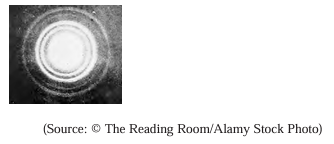
- 5. The image shows a diffraction pattern observed when a beam of electrons is fired at thin gold foil.
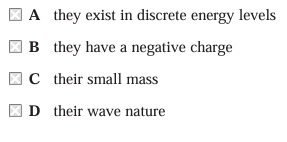
- What property of electrons does this observation demonstrate?
- Answer: D
- Explain:
- A diffraction pattern, such as the concentric rings seen when a beam of electrons passes through a thin gold foil, is a phenomenon characteristic of waves. This observation provides experimental evidence for the wave-particle duality of electrons, a concept first proposed by Louis de Broglie. It demonstrates that electrons, which are typically thought of as particles, can also exhibit wave-like behavior.
- 6. A longitudinal wave is represented on a displacement-distance graph. A positive displacement on the graph indicates a displacement to the right.
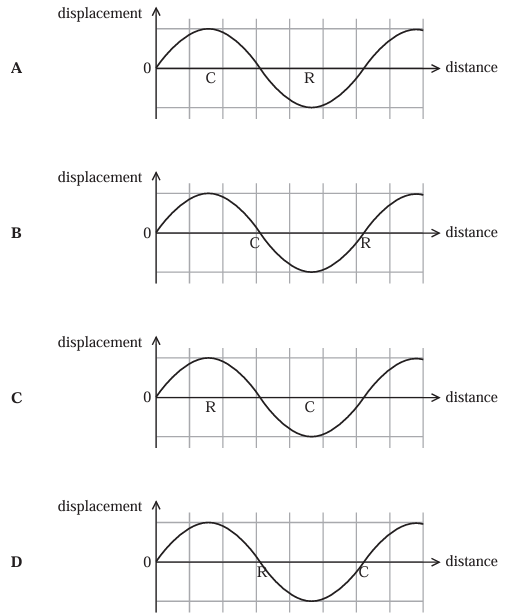
- Which graph shows the correct labelling of possible positions of a compression, C, and a rarefaction, R?

- Answer: B
- Explain:
- A longitudinal wave’s compression and rarefaction points are identified by the particle displacement relative to their equilibrium positions.
- Compression (C):
- – This occurs at the point where the gradient of the displacement-distance graph is most negative. At this point, particles on one side are displaced towards the point and particles on the other side are displaced towards the point, resulting in maximum density.
- Rarefaction (R):
- – This occurs at the point where the gradient of the displacement-distance graph is most positive. At this point, particles on one side are displaced away from the point and particles on the other side are also displaced away, resulting in minimum density.
- Graph B correctly labels the compression (C) at the negative-gradient zero-crossing and the rarefaction (R) at the positive-gradient zero-crossing.
- 7. An electron travels at a velocity v.
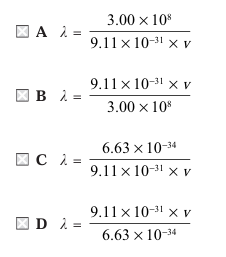
- Which of the following is the correct expression for the de Broglie wavelength λ of the electron?
- Answer: C
- Explain:
- The de Broglie wavelength, [math]\lambda[/math] , is given by the equation
- [math]\lambda = \frac{h}{p}[/math]
- Where h is Planck’s constant and p is the momentum of the particle. For a particle with mass m and velocity v, the momentum is
- [math]p = mv[/math]
- The values for the constants are:
- – Planck’s constant, [math]h = 6.63 \times 10^{-34}\ \text{J·s}[/math]
- – Mass of an electron, [math]m = 9.11 \times 10^{-31}\ \text{kg}[/math]
- Substituting these values into the equation gives:
- [math]\lambda = \frac{h}{mv} \\
\lambda = \frac{6.63 \times 10^{-34}}{(9.11 \times 10^{-31})\, v}[/math] - 8. In an experiment to determine the wavelength of light, three values for the wavelength are obtained and the mean value calculated.
| Wavelength / nm | 466 | 448 | 473 |
|---|---|---|---|
| Mean wavelength / nm | 462 | ||
- What is the uncertainty, in nm, in these results?

- Answer: C
- Explain:
- Find the range of the values
- The range is the difference between the maximum and minimum values in the data set. The given values are 466 nm, 448 nm, and 473 nm.
- – Maximum value = 473 nm
- – Minimum value = 448 nm
- [math]\text{Range} = 473 nm – 448 nm \\ \text{Range} = 25[/math]
- Calculate the uncertainty
- A common method for estimating the uncertainty of a small set of measurements is to take half of the range.
- [math]\text{Uncertainty} = \frac{\text{Range}}{2} \\
\text{Uncertainty} = \frac{25}{2} \\
\text{Uncertainty} = 12.5[/math] - Compare with the options
- The calculated uncertainty is 12.5 nm. This value is closest to option C, which is 14 nm, and also close to option D, which is 11 nm. However, using half the range is a common and simple method. Another method is to find the maximum deviation from the mean, which is also a valid way to estimate uncertainty.
- – Deviation from the mean for 466 nm: 466 – 462 = 4 nm
- – Deviation from the mean for 448 nm: 448 – 462 = 14 nm
- – Deviation from the mean for 473 nm: 473 – 462 = 11 nm
- The largest deviation from the mean is 14 nm. This value corresponds exactly to option C.
- 9. The light emitted from a laptop screen is plane polarised.
- Explain how the plane of polarisation of the emitted light can be demonstrated using a polarising filter. (3)
- Explain:
- To demonstrate the plane of polarization of light from a laptop screen, a polarizing filter can be used.
- A polarizing filter has a specific transmission axis that only allows light waves oscillating parallel to that axis to pass through. Light from a laptop screen is already plane polarized due to the design of LCDs, which use polarizers to create images.
- The demonstration can be performed as follows:
- – Hold the polarizing filter in front of the laptop screen.
- – Rotate the filter slowly.
- – Observe that the brightness of the screen changes as the filter is rotated.
- – The screen will appear brightest when the transmission axis of the filter is aligned with the plane of polarization of the light from the screen.
- – The screen will appear darkest or black when the transmission axis of the filter is perpendicular to the plane of polarization of the light from the screen, as the filter blocks the light completely.
- This change in brightness as the filter is rotated demonstrates that the light from the screen is oscillating in a single plane, which is the definition of plane-polarized light.
- 10. A student carries out an investigation to measure the Young modulus of the material of a wire. He clamps one end of the wire and passes the other end over a pulley as shown.
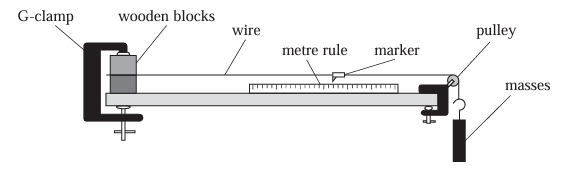
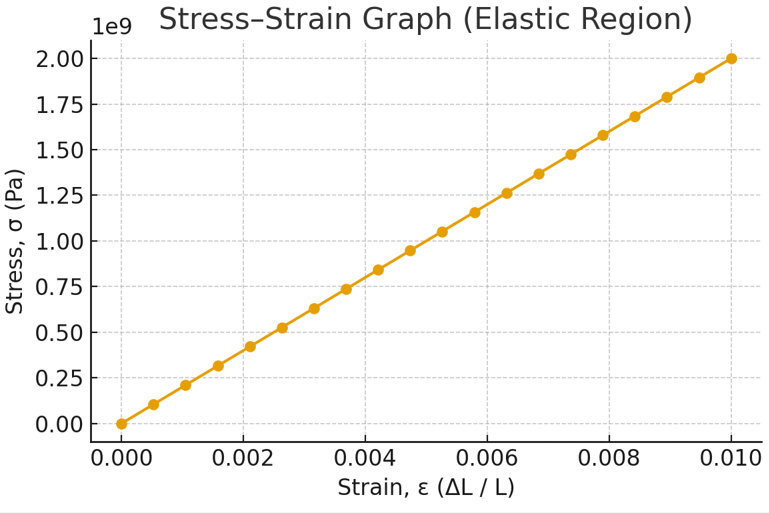
- The student measures the length and diameter of the wire. He hangs masses from the free end of the wire and completes a table with values of mass and extension. Describe how the data collected should be used to determine the Young modulus using a graphical method. Your answer should include a sketch of the expected graph. (4)
- Explain:
- Method to Determine Young’s Modulus
- The data collected should be used to calculate stress and strain for each mass. The Young modulus, (E) is the ratio of stress ([math]\sigma [/math]) strain([math]\varepsilon[/math]) within the elastic limit of the material. The formulas for stress and strain are:
- Stress([math]\sigma [/math])
- The force applied per unit cross-sectional area of the wire.
- [math]\sigma = \frac{F}{A} \\
F = mg \\
A = \pi r^2 \\
A = \pi \left(\frac{d}{2}\right)^2 \\
A = \frac{\pi d^2}{4} \\
\sigma = \frac{mg}{\pi d^2 / 4}[/math] - m is the mass, g is the acceleration due to gravity, and d is the diameter of the wire.
- Strain([math]\varepsilon[/math]) :
- The extension of the wire per its original length.
- [math]\varepsilon = \Delta L / L[/math]
- – [math]\Delta L[/math] is the extension
- – L is the original length of the wire
- A graph should be plotted with stress on the y-axis and strain on the x-axis. The graph is expected to be a straight line through the origin in the region where Hooke’s law is obeyed, which is the elastic region. The gradient of this straight-line portion of the graph is equal to the Young modulus of the wire’s material.
- [math]E = \text{stress}/\text{strain} = \text{gradient}[/math]
- 11. Light can be modelled as a wave.
- (a) Describe how light is transmitted as a transverse wave. (2)
- Explain:
- Light is transmitted as a transverse wavebecause its oscillations are perpendicular to the direction in which the wave travels.
- Light is a type of electromagnetic wave, which means it consists of oscillating electric and magnetic fields. In a light wave, these electric and magnetic fields oscillate at right angles to each other and are both perpendicular to the direction of the wave’s propagation.
- This characteristic oscillation pattern is the defining feature of a transverse wave. The ability of light to be polarized is also evidence of its transverse nature, as polarization restricts these oscillations to a single plane. Unlike sound waves, which are longitudinal and require a medium to travel, light waves can propagate through a vacuum because they do not require a medium.
- (b) Diffraction provides evidence for the wave nature of light.
- Use Huygens’ construction to describe what happens to light waves after passing through a narrow gap. (3)
- Explain:
- The light waves spread out (diffract) as semicircular waves after passing through the narrow gap.
- Huygens’ construction (or principle) describes wave propagation as follows:
- – Every point on an existing wavefront can be considered a source of secondary wavelets that spread out in the forward direction at the same speed as the wave itself.
- – The new wavefront at a later time is the surface tangent to all these secondary wavelets.
- When light waves encounter a narrow gap:
- – The points within the gap act as new, secondary point sources of wavelets.
- – If the gap width is comparable to the wavelength of the light, these wavelets spread out significantly into the region beyond the gap, bending around the edges.
- – The superposition of these spreading wavelets results in the observed diffraction pattern, where the light energy is distributed over a wider area, effectively causing the waves to “bend” around the corners.
- 12. In a conical spring the diameter of the coils increases over its length. The spring can be designed so that each coil fits into the inner diameter of the next coil so they take up minimal space when fully compressed.
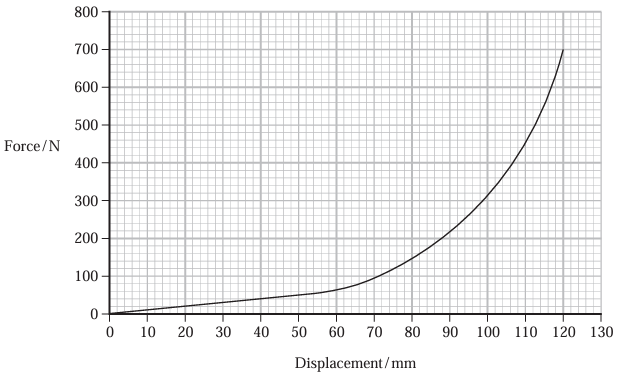
- A conical spring is compressed against a flat surface. The graph shows the force-displacement graph for the spring as the compression force increases from 0 N to the point when the spring is fully compressed.
- The spring obeys Hooke’s law for small compression forces.
- (a) Determine a value for the spring constant of the spring for compression forces up to 60 N. (2)
- Explain:
- The graph force is F = 60 N
- Displacement = 60 mm = [math]60 \times 10^{-3}\ m = 0.06[/math]
- [math]F = kx \\
k = \frac{F}{x} \\
k = \frac{60}{\left(20 \times 10^{-3}\right)} \\
k = 1000\ n/m[/math] - (b) The compression force is increased from 60 N to 220 N.
- Determine a value for the additional energy stored in the spring due to this increase in force. (3)
- Explain:
- Determine the displacements at 60 N and 220 N
- From the graph:
- – At [math]F_1 = 60N[/math], the displacement is approximately [math]x_1 = 60\ \text{mm} = 0.060\ \text{m}[/math]
- – At [math]F_2 = 220N[/math], the displacement is approximately [math]x_1 = 90\ \text{mm} = 0.090\ \text{m}[/math]
- – The area A of a trapezium is given by:
- [math]A = \frac{1}{2} (F_1 + F_2)(x_2 – x_1) \\
A = \frac{1}{2} (60 + 220)(0.090 – 0.060) \\
A = \frac{1}{2} (280)(0.030) \\
A = (140)(0.030) \\
A = 4.2\ J[/math] - Additional energy = 4.2J
- (c) When fully compressed all the coils lie flat inside each other.
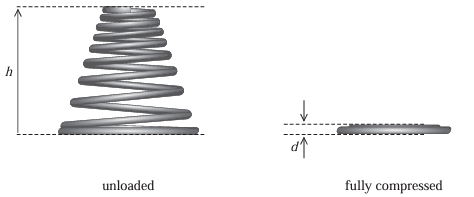
- The height h of the spring when unloaded is 126 mm.
- Calculate the diameter d of the wire in the spring. (2)
- Explain:
- – The height of the height = [math]h = 126\ \text{mm} = 126 \times 10^{-6}\ \text{m}[/math]
- – By counting the number of coil = N = 21 coils
- – Calculate the diameter = d = ?
- [math]h = N \times d \\
d = \frac{h}{N} \\
d = \frac{(126 \times 10^{-6})}{21} \\
d = 6\ \text{mm}[/math] - Diameter = d = 6mm