
12 May 2020
-
SECTION A
-
Answer ALL questions. Write your answers in the spaces provided.
-
All multiple-choice questions must be answered with a cross in the box for the correct answer from A to D. If you change your mind about an answer, put a line through the box and then mark your new answer with a cross.
- 1. A student wanted to measure the thickness of a single sheet of aluminium foil. Which of the following instruments would be the most appropriate to make this measurement?
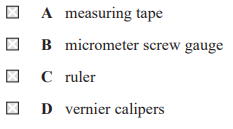
- Answer: B
- Explain:
- A micrometer screw gauge is the most appropriate instrument for measuring the thickness of a single sheet of aluminum foil because it is designed to measure very small lengths with high precision.
- A measuring tape and a ruler are not precise enough to measure the thickness of a very thin object like a single sheet of aluminum foil.
- A vernier caliper is more precise than a ruler but is still generally used for measuring objects that are thicker than a single sheet of foil.
- A micrometer screw gauge is the most suitable instrument for this task due to its ability to measure to an accuracy of [math]0.01\ \text{mm}[/math] or even [math]0.001\ \text{mm}[/math].
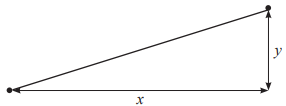
- 2. An object of mass [math]m[/math] is moved from the bottom to the top of a slope. The vertical height of the slope is [math]y[/math]. The horizontal distance between the bottom and top of the slope is [math]x[/math].
- Which of the following gives the gain of gravitational potential energy of the object as it moves from the bottom to the top of the slope?
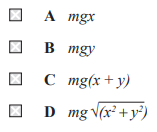
- Answer: B
- Explain:
- The gain in gravitational potential energy ([math]U_g[/math]) of an object is determined by its mass ([math]m[/math]), the acceleration due to gravity ([math]g[/math]), and the vertical change in height ([math]\Delta h[/math]). The formula for gravitational potential energy is:
- [math]\Delta U_g = mg\Delta h[/math]
- In this problem, the vertical height the object is moved is given as [math]y[/math]. Therefore, the gain in gravitational potential energy is [math]mgy[/math]. The horizontal distance [math]x[/math] is not relevant to the calculation of gravitational potential energy.
- 3. A suitcase is being dragged along the ground by the handle in the direction shown.
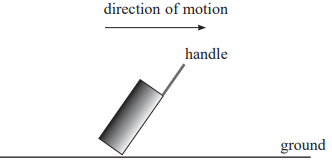
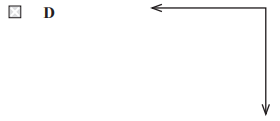
- Which of the following shows the direction of the horizontal and vertical components of force acting on the ground due to the suitcase?
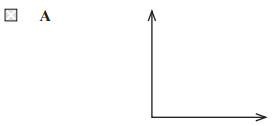
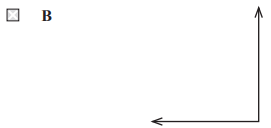
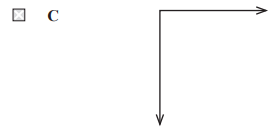
- Answer: C
- Explain:
- The force exerted on the ground by the suitcase is a reaction force to the forces the ground exerts on the suitcase. The ground exerts a normal force (vertical, upward) and a frictional force (horizontal, opposite to the direction of motion) on the suitcase. According to Newton’s third law, the force the suitcase exerts on the ground will have equal magnitude and opposite direction.
- – The horizontal component of the force exerted by the suitcase on the ground is in the direction of motion. This is the reaction to the friction force.
- – The vertical component of the force exerted by the suitcase on the ground is downward. This is the reaction to the normal force.
- Therefore, the correct diagram is the one showing a horizontal force component to the right (in the direction of motion) and a vertical force component pointing down.
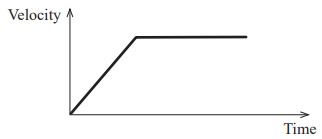
- 4. The graph shows how the velocity varies with time for an object.
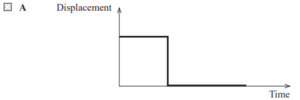
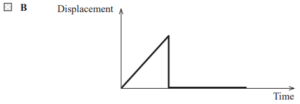
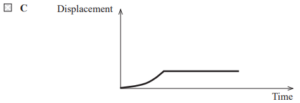
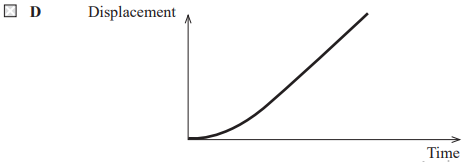
- Which of the following graphs shows how the displacement varies with time for this object?
- Answer: D
- Explain:
- Analyze the velocity-time graph
- The provided velocity-time graph has two distinct segments:
- – Segment 1: The velocity increases linearly from zero. This indicates a constant positive acceleration.
- – Segment 2: The velocity is constant and positive. This indicates zero acceleration.
- Relate velocity to displacement
- The relationship between velocity and displacement is that the displacement is the integral (or area under the curve) of the velocity-time graph.
- – For Segment 1, the velocity is increasing linearly. The displacement will be a curve that is increasing at an increasing rate, which is a parabola opening upwards.
- – For Segment 2, the velocity is constant and positive. The displacement will be a straight line with a constant positive slope, since the object is moving at a constant speed.
- Graph D: Shows displacement increasing with a positive slope that increases over time (a curve), and then transitioning to a straight line with a constant positive slope. This exactly matches the analysis from Step 2.
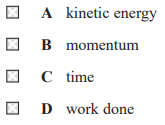
- 5. Which of the following is a vector quantity?
- Answer: B
- A vector quantity is a physical quantity that has both magnitude and direction. A scalar quantity has only magnitude.
- Explain:
- – Momentum is a vector quantity because it is the product of mass and velocity, and velocity is a vector.
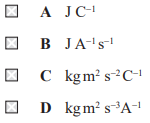
- 6. Which of the following gives the S.I. base units equivalent to the volt?
- Answer: D
- Explain:
By the definition of volt: - [math]V = \frac{J}{C}[/math]
- [math]J = \text{kg m}^{2}\text{s}^{-2}[/math]
- [math]C = \text{A s}[/math]
- [math]V = \frac{\text{kg m}^{2}\text{s}^{-2}}{\text{A s}}[/math]
- [math]V = \text{kg m}^{2}\text{s}^{-3}\text{A}^{-1}[/math]
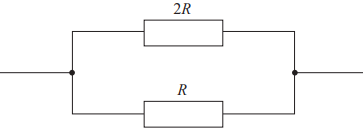
- 7. Part of an electric circuit consists of two resistors. One resistor has a resistance [math]2R[/math] and the other resistor has a resistance [math]R[/math] as shown.
- Which of the following is the equivalent resistance of this combination?
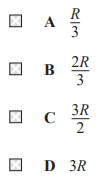
- Answer: B
- Explain:
- Equivalent resistance of parallel resistors:
- [math]\frac{1}{R_{eq}} = \frac{1}{R_1} + \frac{1}{R_2}[/math]
- [math]R_1 = 2R[/math] and [math]R_2 = R[/math]
- [math]\frac{1}{R_{eq}} = \frac{1}{2R} + \frac{1}{R}[/math]
- [math]\frac{1}{R_{eq}} = \frac{3}{2R}[/math]
- [math]R_{eq} = \frac{2R}{3}[/math]
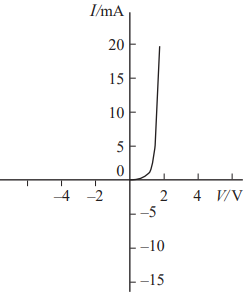
- 8. The graph shows the variation of current [math]I[/math] with potential difference [math]V[/math] for a diode.
- Which of the following statements is correct?
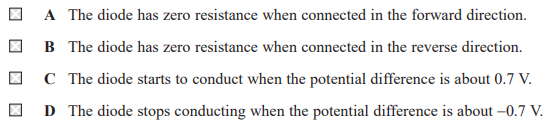
- Answer: C
- Explain:
- The provided graph shows the current-voltage ([math]I[/math]-[math]V[/math]) characteristic curve for a typical silicon [math]p\text{-}n[/math] junction diode.
- – In the forward bias direction (positive [math]V[/math]), very little current flows until the potential difference reaches a certain value, known as the “knee voltage” or “cut-in voltage.”
- – For a silicon diode, this knee voltage is approximately [math]0.7\ \text{V}[/math]. At this point, the diode begins to conduct significant current.
- – Options A and B are incorrect because a diode always has some resistance, and it is not zero.
- – Option D is incorrect because the diode conducts in the forward direction (positive [math]V[/math]) and stops conducting in the reverse direction (negative [math]V[/math]), where the current is nearly zero until the breakdown voltage is reached. The graph clearly shows that current starts to increase around [math]V = 0.7\ \text{V}[/math].